
A technical SEO agency makes sure search engines can crawl, render, index and understand your site, then ties that work to the pages that bring in customers. For fintech, crypto, forex and e-commerce teams, the right agency also works within compliance review, regional restrictions and fast-changing site architecture. Metrics & Co. is a performance marketing agency for crypto, fintech, forex and e-commerce brands that combines technical SEO with AI search optimization, and the selection criteria below reflect that scope.
TL;DR
- Technical SEO covers crawling, rendering, indexing and site structure. On-page SEO covers page-level content and elements. A good engagement handles both, in a sequence.
- A credible scope includes an audit, a prioritized backlog, implementation support, structured data and measurement, not a PDF of warnings.
- Cost depends on site size, number of templates, languages and markets, development access and whether the agency implements or only advises.
- In regulated categories, ask how the agency handles compliance review, market availability pages and YMYL content before you ask about tools.
- Evaluate agencies on scope clarity, evidence of revenue impact and how they report, not on the length of the audit.
Table of Contents
- What a technical SEO agency actually does
- Technical SEO vs. on-page SEO: where they differ and overlap
- What technical SEO services typically include
- How technical work improves crawling, rendering and indexing
- What fintech, crypto, forex and e-commerce teams should assess
- What affects the cost of technical SEO services
- How to evaluate a technical SEO agency
- Where Metrics & Co. fits
- FAQ
- Sources
What a technical SEO agency actually does
Technical SEO is the work that determines whether search engines can reach, read and store your pages. Content and links matter only after that foundation holds. If a key product page is blocked, slow to render or buried five clicks deep, it will not perform regardless of how well it is written.
Search Engine Land’s guide to hiring consultants describes the role as diagnosis and guidance: identifying SEO issues and advising on practical improvements across technical and on-page areas. An agency adds capacity to that. It typically carries the work through to briefs for developers, quality checks on releases and reporting.
In practice the work falls into five groups:
- Crawlability and indexation. Which URLs search engines can fetch, which they are told to ignore and which end up in the index. This covers robots rules, sitemaps, canonical tags, redirects, parameters and duplicate pages.
- Rendering and performance. Whether content that depends on JavaScript is visible to crawlers, and how fast pages load and respond. Google publishes its Core Web Vitals metrics for loading, interactivity and visual stability, and they are the usual yardstick.
- Site architecture and internal linking. How pages connect, how deep key pages sit and whether authority flows to pages that earn revenue.
- Structured data. Markup that describes pages (products, articles, organizations, FAQs) in a format machines read directly.
- Measurement. Search Console and analytics set up so that organic sessions, sign-ups, deposits or orders can be tied back to the pages that produced them.
Technical SEO vs. on-page SEO: where they differ and overlap
Both keywords are searched constantly, and agencies often bundle them. The distinction is simple. According to the same Search Engine Land guide, on-page SEO optimizes page-level content and elements such as titles, headings, URLs, meta descriptions, alt text and internal links, while technical SEO focuses on a site’s ability to be crawled, rendered, indexed and used effectively.
| Area | Technical SEO | On-page SEO |
|---|---|---|
| Question it answers | Can search engines reach and process this page? | Does this page match what the searcher wants? |
| Typical work | Robots rules, canonicals, redirects, rendering, speed, structured data, sitemaps | Titles, headings, copy, URLs, meta descriptions, alt text, internal links |
| Who implements | Developers, with an SEO brief | Content and SEO teams, often in the CMS |
| Failure looks like | Pages missing from the index, wasted crawling, slow templates | Pages indexed but not ranking for the right queries |
Internal linking is the main overlap. It helps search engines understand site structure and page relevance, so it is both an architecture decision and a page-level one. For this reason, buying one without the other usually leaves value on the table. A fast, fully indexable page with weak titles earns little. A well-written page that is not indexed earns nothing.
What technical SEO services typically include
Scopes differ, but a complete engagement for a growth-stage fintech, exchange or online store tends to move through the same stages.
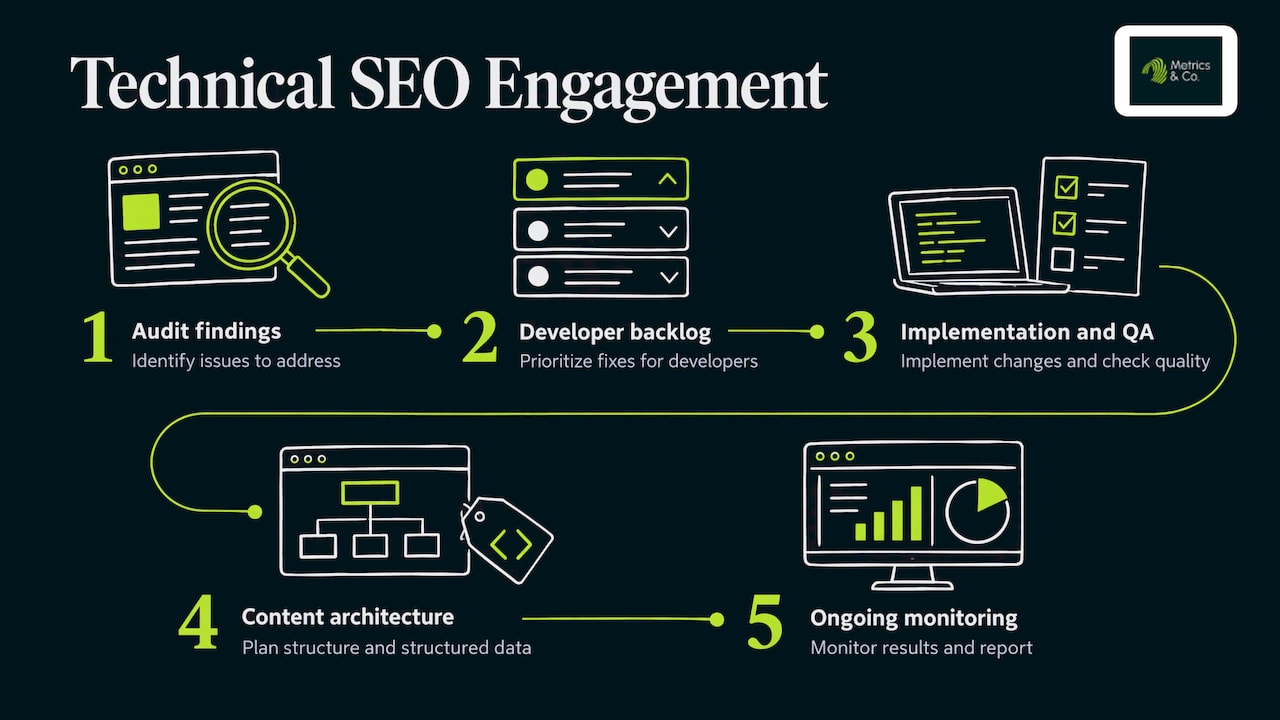
Audit
The audit crawls the site, compares what is crawlable with what is indexed, and reviews templates, rendering, redirects, structured data and internal links. A useful audit ends in ranked findings tied to business impact, not a list of every warning a tool produced. Ask to see how findings are scored.
Prioritized backlog
Findings become tickets that developers can act on: the affected URLs or templates, the expected change, the acceptance test and the reason it matters. Prioritization usually weighs impact, effort and risk. On a regulated site, risk includes whether a change touches content that needs legal review.
Implementation and QA
Some agencies hand over recommendations and stop. Others stay through release, checking staging builds and verifying changes in production. The second model is usually the one that produces results, because technical fixes fail most often in handoff.
Content architecture and structured data
This stage decides how topics, product pages, educational content and market pages are grouped and linked, and which schema types describe each. Metrics & Co. lists audit, content architecture, structured data, compliance and attribution reporting among its capabilities.
Monitoring and reporting
After fixes ship, indexation, crawl behavior, performance and organic conversions are tracked against the baseline from the audit. Reporting should show what changed, what it affected and what remains open.
How technical work improves crawling, rendering and indexing
Search engines have finite resources for any site. Google’s documentation on managing crawl budget for large sites explains that this matters most for very large or frequently changing sites. E-commerce catalogs with filters and parameters, and crypto sites with thousands of asset or token pages, fit that description.
The typical improvements work like this:
- Crawling: Cleaning up duplicate URLs, parameter variations and redirect chains means crawlers spend their visits on pages you want ranked.
- Rendering: Making sure important content and links appear in the HTML a crawler receives, or render reliably, so product details, rates and fees are readable.
- Indexing: Using canonicals, noindex rules and sitemaps deliberately so that the index holds your strongest page for each topic.
- Visibility: Structured data and clear architecture help engines interpret what each page is, which also supports how AI search systems read and cite your content.
That last point is why many teams now ask for technical SEO and AI search optimization together. The same crawlable, well-structured pages are the ones that answer engines can parse. Metrics & Co. integrates technical SEO with AI search optimization (AEO and GEO) so both are planned against one site architecture.
What fintech, crypto, forex and e-commerce teams should assess
Generic technical SEO advice assumes a marketing site that anyone can edit. Regulated and high-volume sites have extra constraints, and they should shape both the brief and the agency choice.
Regulated and YMYL content
Search engines hold pages about money to a higher standard, because errors can cause real financial harm. That is why content architecture for these sites needs author, review and disclosure signals built in. Metrics & Co. covers this in its guide to SEO architecture for YMYL content in regulated markets, and in its piece on a compliance-safe content refresh system.
Market availability and international sites
Products in these categories are often available in some countries and not others. Pages, hreflang annotations, geo-redirects and disclaimers all need to agree. A wrong redirect can send crawlers, and users, to the wrong market or block them entirely. See the notes on market availability pages for fintech SEO for how this is structured. Metrics & Co. also manages international and multilingual campaigns.
Heavy JavaScript apps and gated flows
Many fintech and exchange sites mix a public marketing layer with an authenticated app. The agency must know which parts should be crawlable, which should not and how the two share templates and navigation. The fintech-specific checklist is in this guide to technical SEO for fintech in regulated markets.
Large catalogs
Online stores need controlled faceted navigation, consistent product schema and clear handling of out-of-stock and variant pages. These decisions affect both crawl efficiency and the pages that convert. The same principles feed e-commerce marketing across organic and paid.
Measurement
If the business cares about funded accounts, deposits or orders, the agency should connect organic landing pages to those events. Without that, technical wins are measured only in crawl stats and rankings, which are hard to defend at budget time.
What affects the cost of technical SEO services
Prices vary widely, and agencies often quote per project or per month instead of publishing rates. Rather than anchor on a headline number, understand the factors that move a quote:
| Cost driver | Why it matters |
|---|---|
| Site size and number of templates | More URLs and page types mean more to crawl, diagnose and test |
| Languages and markets | Each market adds hreflang, content and compliance checks |
| Tech stack | Heavy client-side rendering or custom platforms need deeper analysis |
| Implementation model | Advice only, hands-on support with developers, or full QA through release |
| Engagement type | One-off audit, project, or ongoing retainer |
| Compliance workflow | Legal review steps add coordination time |
| Measurement setup | Attribution and reporting work on top of the SEO itself |
The most useful question in a sales call is not “how much?” but “what exactly is in scope, what is not and how will progress be measured?” Metrics & Co. works on project and retainer terms and does not publish technical SEO pricing. Its stated approach is to make buyer objectives, evidence, scope and measurement limits explicit before work begins, which is the same information a buyer needs to compare quotes fairly.
How to evaluate a technical SEO agency
Use criteria that separate real capability from presentation.
- Scope clarity. The proposal should list deliverables, owners and what happens after the audit. A vague “technical optimization” line is a warning sign.
- Relevant category experience. An agency that understands regulated products knows why a disclaimer template, a licensing page or a market selector affects SEO. Ask for examples from your category.
- Prioritization logic. Ask how it ranks fixes. The answer should reference impact on revenue-bearing pages, not issue counts.
- Developer collaboration. Technical SEO succeeds or fails in your engineering queue. Find out how tickets are written, reviewed and verified.
- Measurement. The agency should be able to describe attribution from organic landing pages to your core conversion event.
- Outcome evidence. Look for results expressed as business outcomes. Metrics & Co. reports over $500 million generated in client revenue and a 25.5x peak return on ad spend across its performance marketing work.
- Fit with the wider program. Technical SEO rarely stands alone. It supports content, paid acquisition and AI visibility, so an agency that plans these together avoids conflicting recommendations.
Where Metrics & Co. fits
Metrics & Co. focuses on crypto, fintech, forex and e-commerce brands, where platform rules and regulation shape what can be published and how. Its SEO and organic growth service covers technical SEO, content architecture and structured data for these markets, and it sits alongside paid acquisition, content and analytics under one team.
For teams that want a defined first step on the AI search side, the one-time AI visibility campaigns are published at fixed prices: Starter at $1,500, Premium at $3,000 and Viral at $10,000, each one-off. Details are on the AI visibility page. Technical SEO and organic growth engagements are scoped individually, and the full list of services is on the services page.
If the site has crawl, indexation or market-page issues that are holding back organic acquisition, the next step is a scoping conversation through Metrics & Co..
FAQ
What does a technical SEO agency do?
It audits and fixes the factors that control whether search engines can crawl, render and index your site, including site structure, redirects, structured data and performance. It then prioritizes the findings, works with developers to implement them and reports on the effect. The aim is to make your revenue-bearing pages reliably discoverable.
Is technical SEO consulting different from working with an agency?
Consulting centers on diagnosis and guidance: finding issues and advising on what to change. An agency usually adds execution capacity, such as writing tickets, checking releases and running reporting. Choose based on how much of the implementation your internal team can carry.
Are on-page SEO services part of technical SEO?
They are related but separate. On-page work handles titles, headings, copy, URLs, alt text and internal links on each page, while technical work handles crawling, rendering and indexing across the site. Internal linking sits between the two, and most strong programs combine them.
How much does a technical SEO agency cost?
It depends on site size, templates, languages, tech stack, implementation model and whether the engagement is a one-off audit, project or retainer. Because of this, scope matters more than a headline figure. Ask each agency to list deliverables and measurement so quotes can be compared on the same basis.
Do regulated businesses need a specialist technical SEO agency?
Yes, it is worth it. Fintech, crypto and forex sites combine YMYL content standards, market restrictions and compliance review with technical constraints. An agency that works within those limits can plan architecture, market pages and content updates so that fixes are shipped without compliance rework.
Sources
- SEO consultants guide: When to hire and what to expect, Search Engine Land
- Managing crawl budget for large sites, Google Search Central
- Web Vitals, web.dev