
An ecommerce content strategy is a plan for what your store publishes, who each piece is for and which commercial outcome it supports. It covers more than a blog. Product pages, collection pages, email and post-purchase messages all count as content, and each one should map to a stage of the customer journey. The brands that get measurable growth from content treat it as an acquisition channel with goals, owners and attribution. Metrics & Co. builds this kind of program for e-commerce, fintech, crypto and forex brands, combining SEO, content and AI search optimization under one measurement plan.
This guide is written for growth teams that hold the budget: how to set goals, audit what exists, choose formats, distribute content, raise quality and measure results.
TL;DR
- Define content by the commercial outcome it serves (qualified visits, add-to-cart rate, repeat purchase), not by the number of articles published.
- Start with an audit of existing pages. Keep, improve, consolidate or retire each one before commissioning anything new.
- Product and category pages are your highest-intent content. Blog posts, video, reviews and user-generated content support them at earlier and later journey stages.
- Quality means original information, first-hand experience and answers to real buyer questions, which is what Google’s own guidance asks for.
- Measure with consistent UTM tagging and conversion reports, and review results monthly so the plan changes with the data.
Table of Contents
- What an ecommerce content strategy covers
- Step 1: Turn a business priority into a content goal
- Step 2: Research the audience and the buying journey
- Step 3: Audit what you already publish
- Step 4: Choose topics and formats that fit the store
- Step 5: Produce content that is worth ranking
- Step 6: Distribute across channels
- Step 7: Measure and improve performance
- A sample 90-day plan
- Where a specialist agency fits
- FAQ
- Sources
What an ecommerce content strategy covers
A general content marketing plan usually revolves around articles that attract readers. An ecommerce plan has a wider scope because the store itself is a content surface. Shopify’s enterprise guide describes the strategy as a plan for the content a retailer creates, who it is for and why, and it includes product pages, collection pages, email and post-purchase experiences alongside editorial content.
In practice, the strategy answers five questions:
- Which business outcome does content serve? Revenue from organic search, a lower blended acquisition cost, higher repeat purchase rate, or a higher conversion rate on paid traffic.
- Who is the content for? Segments defined by what they need and what they type into search, not only demographics.
- Which journey stage does each asset address? Awareness, consideration, decision, and the period after purchase.
- Which formats and channels carry it? Store pages, a blog, video, email, social and increasingly AI answer engines.
- How will you know it worked? The metric, the tracking method and the review rhythm.
The search term “content marketing for ecommerce” describes the same discipline from the execution side. The strategy is the decision layer; content marketing is the production and distribution that follows from it.
Step 1: Turn a business priority into a content goal
Most weak content programs fail at the first step: the goal is an output (“publish eight posts a month”) rather than an outcome. A usable goal names one business priority, one metric, a baseline and a deadline.
Examples of goals written as outcomes:
- Increase organic revenue from category pages by a stated percentage within two quarters.
- Raise the conversion rate of top-50 product pages by adding answers to the objections buyers raise.
- Grow non-branded organic sessions to buying-guide content by 20% in the next calendar year. Shopify’s content planning guide uses a 20% blog traffic increase as its example of a goal that supports a brand-awareness priority.
Tie each goal to a budget line. A traffic goal and a margin goal lead to different content: traffic favors broad educational topics, margin favors comparison and high-ticket buying guides where fewer competitors publish.
For regulated or high-scrutiny categories, such as crypto exchanges, forex platforms and fintech products that sell through ecommerce-style flows, the goal-setting step also records what claims the brand may make, which platforms restrict its ads and where measurement has limits. Metrics & Co. makes buyer objectives, evidence, scope and measurement limits explicit before work begins, which keeps later content decisions grounded in what can be proven.
Step 2: Research the audience and the buying journey
Audience research for content differs from persona exercises that end in a slide. The useful output is a list of questions, grouped by journey stage, that your content must answer.
Start where the questions already exist:
- Customer support tickets, live chat transcripts and sales call notes.
- Product reviews, especially one- and two-star reviews, which show the objections that stop purchases.
- Site search queries and Google Search Console queries that are phrased as full questions.
- Surveys of existing customers.
Search Engine Land’s content strategy guide recommends this same order: begin with recurring questions from inquiries, tickets and sales calls, then validate demand with keyword tools and prioritize topics with solid search volume, clear intent and manageable difficulty.
Map questions to journey stages
A simple four-stage map is enough for most stores:
| Stage | Shopper’s question | Typical content |
|---|---|---|
| Awareness | What solves this problem? | Educational articles, guides, short video |
| Consideration | Which option fits me? | Comparisons, buying guides, category pages |
| Decision | Is this the right one, and is it safe to buy? | Product pages, reviews, sizing and shipping answers |
| Post-purchase | How do I get value and buy again? | Onboarding emails, care guides, replenishment reminders |
Mailchimp’s ecommerce guide uses a similar funnel: educational posts and infographics at awareness, detailed guides and pros-and-cons comparisons at consideration, and customer reviews, detailed specifications and social proof at conversion.
A behavior-based alternative is the See, Think, Do, Care model that Search Engine Journal’s ecommerce content guide recommends. It segments audiences by commercial intent rather than demographics, which makes it easy to decide how much to invest at each level.
Step 3: Audit what you already publish
Before commissioning new content, inventory what exists. Most established stores have thin category pages, outdated posts that compete with each other for the same query, and product pages that repeat manufacturer copy.
A workable audit has four parts:
- Inventory. Export every indexable URL with its type (product, category, article, landing page).
- Add performance data. Organic sessions, conversions, revenue, rankings and engagement for each URL.
- Classify. Note the audience, search intent and journey stage each page serves.
- Decide. Keep, improve, consolidate or retire.
Shopify’s content audit guide follows the same sequence and adds that analysis should flag content gaps cross-referenced with search volume, on-page SEO issues and technical problems such as broken links, slow pages and duplicate content.
Two outcomes of the audit deserve special attention:
- Consolidation. Several weak posts on one topic often rank better as one thorough page with redirects from the others.
- Gaps at the decision stage. If your best-selling products have the thinnest pages, that is usually the highest-return fix available.
The technical side of an audit (crawl behavior, indexation, structured data, site architecture) determines whether good content can be found at all. Metrics & Co. integrates technical SEO with its content work for this reason, so the audit covers both what the pages say and how search engines and AI systems read them.
Step 4: Choose topics and formats that fit the store
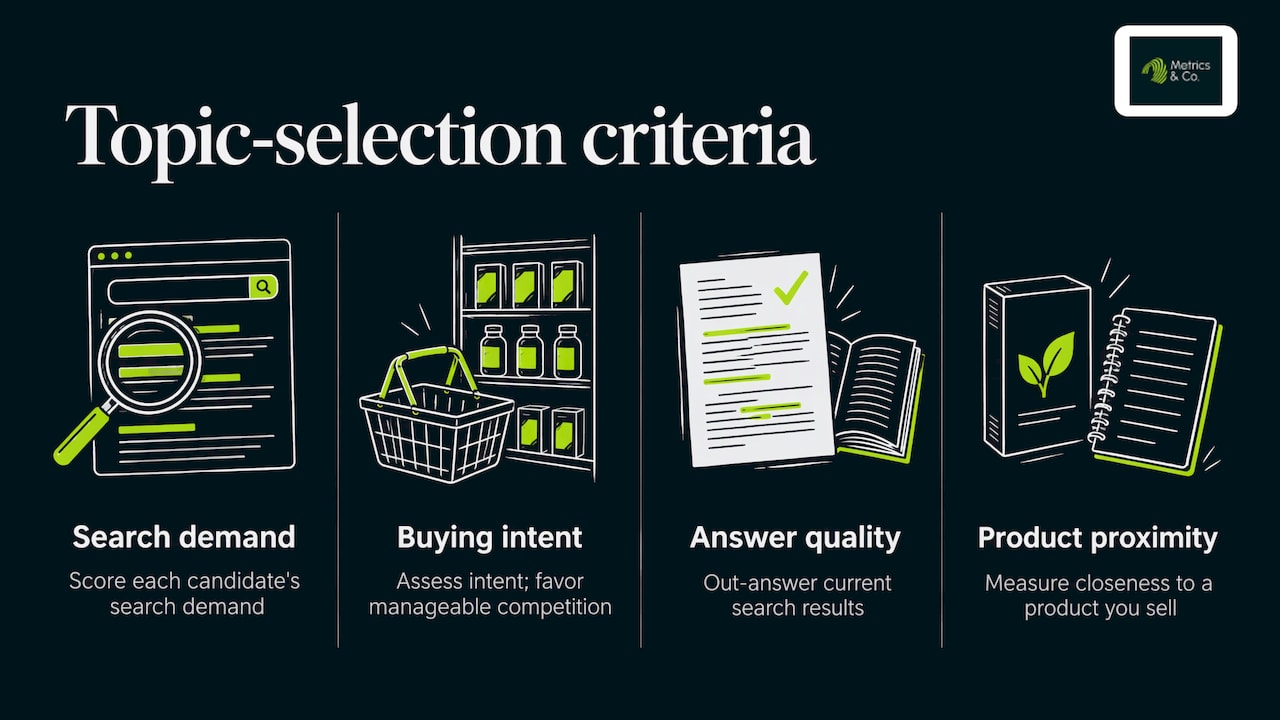
Topic selection is a prioritization exercise. Score each candidate by search demand, buying intent, how well you can answer it better than current results, and how close it sits to a product you sell. A rough filter is to publish first where intent is high and competition is manageable.
Product and category content
These pages carry the highest purchase intent and should be treated as content, not just inventory. Amazon’s seller guidance on content marketing for ecommerce recommends internal links from educational content to product pages, keyword research, proper headings and fast mobile-friendly pages.
Useful additions to product detail pages include blocks that answer buyer anxieties: sizing and fit, compatibility, materials, care, warranty, shipping and returns. Search Engine Land suggests mining Google Search Console conversational queries and low-star reviews to write genuine FAQs.
SEO articles and buying guides
Articles earn traffic from earlier-stage searches and pass readers to category and product pages. The most effective types for stores are buying guides, comparisons, how-to content tied to product use, and “is it worth it” content built on real testing.
Video and images
Visual content has measurable commercial weight on product pages. A Profitero study of about 4,500 US products on Amazon, using data from July to November 2020, found that adding videos was associated with average sales lifts of 58% on Amazon.com, and more images with 45%. The study measured marketplace listings brought up to bestseller benchmarks, so treat it as direction for your own product pages, not a forecast for your store.
User-generated content
Customer photos, reviews and questions work because shoppers trust other customers. Search Engine Land’s analysis of organic content investments recommends reposting customer photos and integrating reviews and customer images into product pages. Build the collection into your post-purchase email flow so that it runs continuously.
Choose formats the audience already consumes. Search Engine Land’s guide to content types advises matching format to niche, such as video for skill-based topics and written content where readers expect text, and checking where your audience gathers.
Step 5: Produce content that is worth ranking
Improving content quality is mostly a matter of adding what competitors do not have. Google’s guidance on helpful, people-first content asks for original information, a substantial and complete treatment of the topic and first-hand expertise. For product reviews, it says trust grows when you show how many products you tested, what the results were and how the tests were run, with evidence such as photographs.
A quality checklist for every asset:
- Original input. Your own test results, sales data, customer questions or photography, not a rewrite of the first page of search results.
- A complete answer. The reader should not need to return to search to finish the task.
- Named experience. Show who wrote or reviewed the page and why they know the product.
- Proof on the page. Reviews, specifications, return terms and shipping details where a buyer expects them.
- Machine-readable structure. Product, review and offer markup helps search engines understand the page. Google documents the requirements for product snippet structured data, which can make a page eligible for enhanced results.
An editorial standard written once and applied to every brief prevents most quality problems. It should specify the sources allowed, how claims are verified and who signs off. This matters most where content touches money. In crypto, forex and fintech, regulators and ad platforms scrutinize claims, so a compliance review belongs inside the workflow. Metrics & Co. lists compliance among its capabilities and covers how that works for finance brands in its article on SEO architecture for YMYL content.
Step 6: Distribute across channels
Publishing is half the work. Shopify’s Help Center on creating a content marketing strategy lists store pages, a blog, social media, email and SMS, sign-up forms and creator collaborations as channels, and advises tailoring coordinated content to each channel rather than duplicating it.
A distribution routine that scales:
- Search first. Optimize each page for the queries it targets, and link it into category and product pages.
- Email second. Segment subscribers by stage: browsers get guides, buyers get usage and replenishment content.
- Social and creators third. Cut video and image assets from the same source material for each platform.
- Paid amplification where proven. Promote the content that already converts organically. This is where paid advertising and content planning share a measurement plan.
- AI answer engines. Clear structure, direct answers and authoritative references help assistants cite your pages. This is the area covered by AEO and GEO work, which tailors content so brands appear in AI-generated answers.
Step 7: Measure and improve performance
Improving content performance requires picking metrics by job. Awareness content is judged by reach and organic traffic, engagement content by time on page and engagement rate, and demand content by conversion rate and qualified actions.
Shopify’s content metrics guide recommends tracking SEO, traffic, engagement, conversion, revenue and distribution metrics across owned, earned and paid channels, then using the results to improve calls to action, add internal links, refine headlines and metadata, and expand topics that perform.
| Content job | Primary metrics | Typical action when it underperforms |
|---|---|---|
| Awareness | Non-branded organic sessions, impressions, new users | Rework titles, expand topic coverage |
| Consideration | Scroll depth, time on page, click-through to products | Improve comparisons, add internal links |
| Decision | Product page conversion rate, add-to-cart rate | Answer objections, add proof and media |
| Retention | Repeat purchase rate, email click-through | Refine post-purchase flows |
Attribution
Content often influences a purchase several sessions before it happens. Use consistent UTM parameters on every campaign link, and review analytics conversion reports alongside assisted conversions. Where tracking is incomplete, state the limits in the report instead of overstating results. Metrics & Co. lists attribution reporting and analytics optimization among its capabilities for this reason.
Review rhythm
Hold a monthly review of what moved and a postmortem after major launches or promotions, a practice Shopify’s planning guide describes. Each review should end with a decision: update, expand, consolidate or stop.
A sample 90-day plan
A team starting from scratch can sequence the work like this:
- Days 1 to 30: Set one to three outcome goals, run the audit, fix technical blockers and rewrite the 20 highest-revenue product and category pages.
- Days 31 to 60: Publish the first buying guides and comparisons for high-intent topics, launch the review and photo collection flow, and set up UTM standards and a reporting dashboard.
- Days 61 to 90: Add video for top products, begin segmented email content, review the first results and re-prioritize the backlog.
The discipline matters more than the volume. A small set of pages tied to revenue, measured honestly and improved monthly, outperforms a large calendar of posts with no owner.
Where a specialist agency fits
A content strategy for a store in a regulated or platform-constrained market involves SEO, paid media, analytics, compliance and creative work that must agree with one another. Metrics & Co. offers these as one engagement for crypto, fintech, forex and e-commerce brands: e-commerce marketing covering SEO, paid acquisition and AI visibility, plus content marketing with content strategy, production and creative concepts.
For brands that want to start with AI search visibility, the one-off packages on the AI visibility page are published at $1,500 (Starter), $3,000 (Premium) and $10,000 (Viral). The wider service range is on the services page.

Metrics & Co. reports more than $500 million in client revenue generated and a 25.5x peak return on ad spend across its client work.
FAQ
What is the first thing to do when building an ecommerce content strategy?
Write one goal as a measurable outcome with a metric and a deadline, such as lifting conversion on your top product pages. Then audit existing content, because most stores can gain more from improving current pages than from publishing new ones.
Is a blog necessary for ecommerce content marketing?
Not as a starting point. Product and category pages carry the most purchase intent, so improve them first. A blog becomes valuable when you have buying guides, comparisons and how-to topics that capture earlier searches and link readers to products.
How do I improve content quality on an existing store?
Add what only you can provide: original photos and video, test results, customer questions answered in full and visible reviews. Google’s guidance for people-first content asks for original information, completeness and first-hand expertise, so rewrite thin pages against those three tests.
Which metrics should I track for content performance?
Match metrics to each page’s job. Use non-branded organic sessions for awareness, engagement rate and scroll depth for consideration, and conversion rate, add-to-cart rate and revenue for decision pages. Tag campaign links with UTM parameters so content can be connected to purchases.
Does ecommerce content strategy differ for crypto, fintech and forex brands?
The framework is the same, but claims, ad platform rules and measurement limits need to be defined before production. Add a compliance review to the workflow and document what the reporting can and cannot attribute.
Sources
- Ecommerce Content Strategy: Enterprise Guide (2026)
- Content Planning: How to Create a Content Plan
- Content strategy in 6 steps: A practical guide
- Ecommerce Content Marketing Strategies for Growth
- How to Create a Content Strategy for Ecommerce Sites
- Content Audit: 6 Steps for Ecommerce Sites
- Content marketing for ecommerce - Sell on Amazon
- 7 organic content investments that drive ecommerce ROI
- The ROI of improving product content
- 17 types of content marketing
- Creating Helpful, Reliable, People-First Content
- Product snippet structured data
- Shopify Help Center: Create a content marketing strategy
- How To Use Content Metrics
Metrics & Co. is a performance marketing agency for crypto, fintech, forex and e-commerce brands, offering paid acquisition, SEO, AI search optimization, content and analytics. Learn more at Metrics & Co..