
Financial services SEO is the work of earning unpaid search visibility for a financial product, so that qualified buyers find your brand when they research it. Search engines send an estimated 2.2 billion organic visits to finance-industry websites each month. For fintech, crypto and forex teams, the harder questions are how to rank in a category Google treats with extra scrutiny, how to publish content that compliance will approve, and how to be named when AI systems answer the query. Metrics & Co. builds this work as one program, covering technical SEO, trust-focused content and AI search optimization for regulated and platform-restricted markets.
TL;DR
- Google treats financial topics as YMYL (Your Money or Your Life), so rankings depend on demonstrated expertise, accurate content and a technically sound site.
- Content for financial brands needs a review chain: a credentialed expert, then compliance, before anything is published.
- Technical basics (HTTPS, speed, mobile, structured data, clean internal linking) are the foundation, and they need to be built with regulated pages in mind.
- AI answer engines now name institutions directly, so SEO has a second goal: being cited, not only being ranked.
- Measure leads, engagement and AI citations, not traffic alone, and set the measurement limits before the work starts.
Table of Contents
- What makes SEO in financial services different
- How the reader differs: bank, fintech, crypto, forex, e-commerce
- Build the strategy around buyers, intent and keywords
- Create content that demonstrates E-E-A-T
- Technical SEO for financial websites
- Authority and links
- AI search: being named, not only ranked
- Measure what ties to revenue
- How to evaluate a financial services SEO partner
- Where Metrics & Co. fits
- FAQ
- Sources
What makes SEO in financial services different
General SEO advice assumes a missed ranking costs you a click. In finance, inaccurate content can cost the reader money, and search engines know it. Google places finance in its YMYL category, which holds pages to stricter content-quality standards. Search Engine Journal notes that this category holds finance sites to a higher standard, with expertise and trust signals weighing heavily in rankings.
Three other pressures shape the work:
- Competition. Finance is a crowded search category. Paid CPCs in the sector can run from $30 to $150, which is why organic visibility that compounds over time carries so much weight in the budget.
- Regulation. Financial institutions face stringent regulations that require compliance review of what they publish. A page that ranks but cannot survive review is a liability.
- Legacy systems. In an Adobe survey reported by Search Engine Journal, 61% of retail banks named legacy systems as a top obstacle for marketing and customer experience teams. Fintechs have fewer legacy constraints but often have their own: fast-shipping product teams, JavaScript-heavy apps and frequently changing regulated copy.
Crypto and forex add platform constraints. Ad platforms limit what these brands can promote, which pushes more of the acquisition burden onto organic search and content. That is the practical reason many growth teams in these categories invest in SEO early.
How the reader differs: bank, fintech, crypto, forex, e-commerce
The same principles apply across the sector, but the priorities differ.
| Business type | Main SEO goal | Typical pressure point |
|---|---|---|
| Fintech (payments, lending, neobanks) | Product and comparison pages that convert into sign-ups | Compliance-approved copy, app-heavy sites, crowded commercial keywords |
| Crypto and DeFi | Visibility for education and product pages, authority signals | Platform and ad restrictions, trust and E-E-A-T signals |
| Forex platforms | Organic growth for trading and education queries | Jurisdiction-specific rules, multilingual markets |
| E-commerce with financial products (BNPL, checkout finance) | Category and product page revenue | Scale of pages, technical hygiene, attribution |
A plan that ignores these differences usually turns into a generic blog calendar. A plan that starts from the buying journey, the regulatory limits and the markets served produces pages the business can actually publish.
Build the strategy around buyers, intent and keywords
Financial keyword research follows the same logic as any other, with one extra filter: can this page be written accurately and approved by compliance?
- Define the buyer. A CFO evaluating a treasury tool, a retail trader comparing platforms and a developer integrating a payments API search differently. Write down the buyer, the decision they are making and the objections they raise.
- Map intent to page type. Informational queries (“what is a margin call”) need education pages. Comparison and commercial queries need product pages with clear terms and disclosures. Branded and navigational queries need clean, fast, trustworthy landing pages.
- Prioritize by value, not volume. A keyword with 880 monthly searches and a clear commercial buyer can be worth more than one with 20,000 informational searches. Tie each cluster to a lead or revenue outcome before commissioning content.
- Check the regulatory fit. Some queries invite claims about returns or risk that need specific disclosures. Flag them before writing, not after.
- Audit what exists. A content audit of current pages shows what to update, merge or remove before adding anything new. In regulated brands, updating an approved page is often faster than launching a new one.
Metrics & Co. states buyer objectives, evidence, scope and measurement limits explicitly before work begins, so that each cluster has an agreed purpose and a way to be judged.
Create content that demonstrates E-E-A-T
E-E-A-T stands for experience, expertise, authoritativeness and trustworthiness: the qualities Google looks for, and the YMYL category weighs them most. Because inaccurate finance content can harm readers, Semrush recommends that financial experts write or review content and that their credentials are displayed on the page.
A workable production chain for a regulated brand has three layers, matching the process Ahrefs describes for human and AI-assisted content:
- Draft with the compliance rules built into the brief or prompt.
- Expert review by a credentialed professional, such as a CFA or CFP, who checks accuracy and adds practical judgment.
- Compliance sign-off before publishing, with a record of what was approved.
Practical signals that support this on the page:
- Named authors and reviewers with credentials and linked profiles.
- A visible date and a last-reviewed date on pages with rates, fees or rules.
- Citations to regulators and primary sources rather than competitors’ blogs.
- Clear company information: who operates the product, where it is licensed, how to contact support.
Metrics & Co. publishes detailed guidance on this for YMYL content and E-E-A-T for financial, crypto and fintech brands and on E-E-A-T signals for crypto and DeFi. Its content marketing service for crypto, fintech and forex is described on the content marketing page.
Technical SEO for financial websites
Trust is partly technical. Pages that load slowly, break on mobile or lack encryption undermine both rankings and conversion. The foundations Ahrefs lists for financial sites are:
- Full mobile responsiveness.
- Fast page loading.
- HTTPS encryption, since unencrypted sites risk SEO penalties.
- Clear navigation and internal linking.
- Structured data, which helps search engines understand content, authors and services.
Semrush adds that a technical audit should cover crawling and indexing, Core Web Vitals (Google’s measures of loading speed, responsiveness and visual stability) and HTTPS.
For fintech and crypto, a few issues come up repeatedly:
- App-like front ends. If key content renders only through JavaScript, confirm search engines can see it.
- Gated and geo-restricted pages. Jurisdiction restrictions need to be handled so that search engines can still reach and understand the pages that should rank.
- Site architecture. Regulated content works best when product, education and compliance pages are organized in clusters with clear internal links.
- Multilingual and international setups. Forex and crypto brands often serve several markets, so language and regional versions need consistent handling.
Metrics & Co. covers these topics in its guides to technical SEO for fintech in regulated markets and SEO architecture for YMYL content. It integrates technical SEO with AI search optimization, so that the site structure serves both traditional rankings and AI citations.
Authority and links
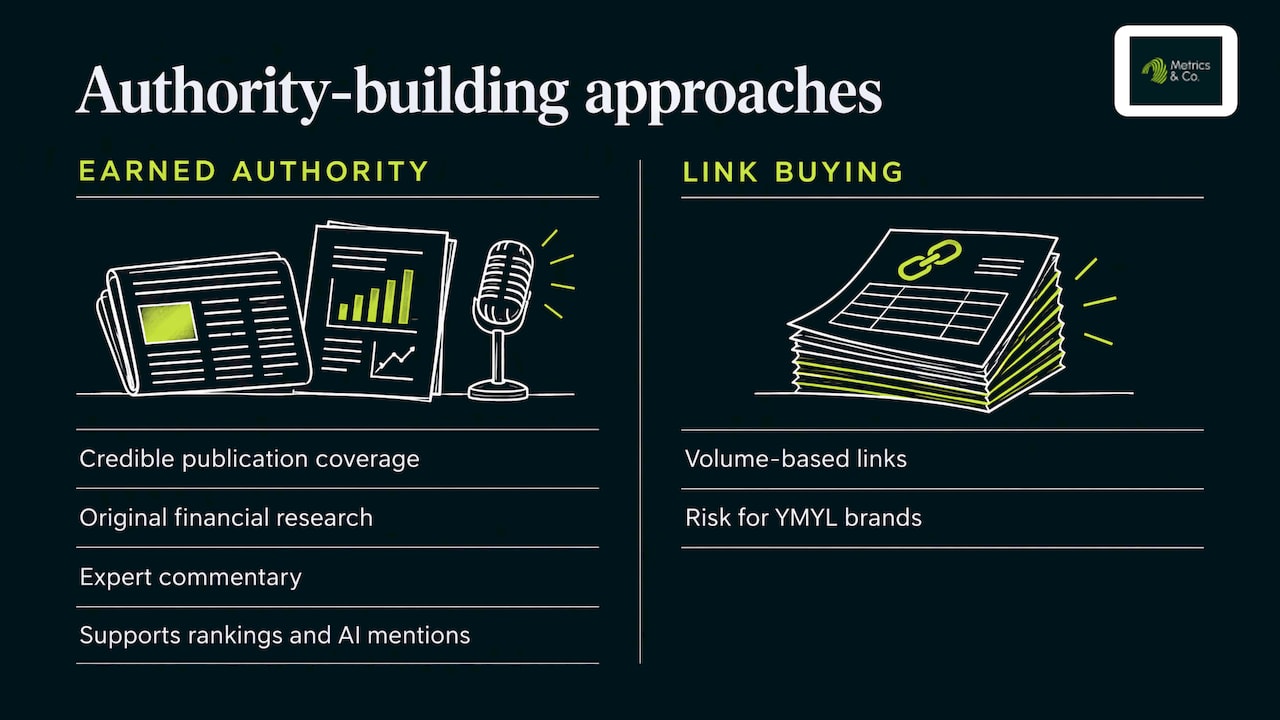
Links from credible publications remain a core trust signal for finance. Earned coverage, original research and expert commentary tend to work better than volume-based link buying, which carries risk for a brand in a YMYL category. Digital PR, built around data the company can legitimately publish, supports both rankings and the brand mentions AI systems draw on. Metrics & Co. offers digital PR within its SEO work for crypto, fintech and forex brands, and has written on building fintech brand authority with AI-generated financial research.
AI search: being named, not only ranked
Search is no longer only ten blue links. Visa’s whitepaper on AI-mediated discovery states that AI systems now synthesize answers to financial product queries and name institutions directly, so an institution missing from those answers is missing from consideration. The same paper argues that SEO compounds over time and can reduce reliance on paid media and cost per acquisition as advertising costs rise.
For a growth team, this adds a second layer to the program, usually called answer engine optimization (AEO) and generative engine optimization (GEO). The practical elements are:
- Clear, quotable answers on pages that address the questions buyers ask, structured so a system can extract them.
- Entity clarity. Consistent company, product and author information across the site and the web, supported by structured data.
- Trust signals that AI systems can verify: licensing details, credentials, primary-source citations.
- Content architecture that covers a topic in depth rather than in isolated posts.
Metrics & Co. has published tactics on answer engine optimization for B2B fintech, trust signals that AI search engines cite and AEO and GEO content architecture for regulated markets. Its AI search optimization service puts this work into practice.
Measure what ties to revenue
Traffic alone is a weak report for a regulated business. A useful measurement set has four parts:
- Business outcomes: qualified leads, sign-ups, funded accounts or e-commerce revenue from organic search, tracked through attribution that the team agrees on in advance.
- Visibility: rankings and impressions for the priority keyword clusters.
- Engagement: visit duration, return visits, bounce rate and scroll depth. Unusually low engagement can signal that content does not match search intent.
- AI presence: how often your brand is named and cited in AI answers for the queries that matter to your buyers.
Write down the limits as well. Organic results build over months, attribution across channels is imperfect, and some regulated conversions happen offline or inside apps. Agreeing on these limits at the start is what makes the later reporting credible. Metrics & Co. lists analytics and tracking, along with funnel optimization, among its services, so measurement is set up alongside the content and technical work.
How to evaluate a financial services SEO partner
When a fintech, crypto or forex team weighs an agency, these questions separate a specialist from a generalist:
- Does it work in your regulated category, and does it understand platform restrictions?
- Is there a defined review path with your compliance team?
- Does the scope cover technical SEO, content and AI search together, or only one?
- Are objectives, evidence and measurement limits stated before the work begins?
- Does reporting connect to leads and revenue?
Pricing varies with scope: the number of markets and languages, the volume of content that needs expert review, the technical condition of the site and whether paid and AI search work are included. A written scope with agreed outcomes is the most reliable way to compare proposals.
Where Metrics & Co. fits
Metrics & Co. is a performance marketing agency for crypto, fintech, forex and e-commerce brands. Its SEO and organic growth work sits alongside paid acquisition, content, analytics and AI search optimization, and the company reports over $500 million generated in client revenue and a peak 25.5x return on ad spend.
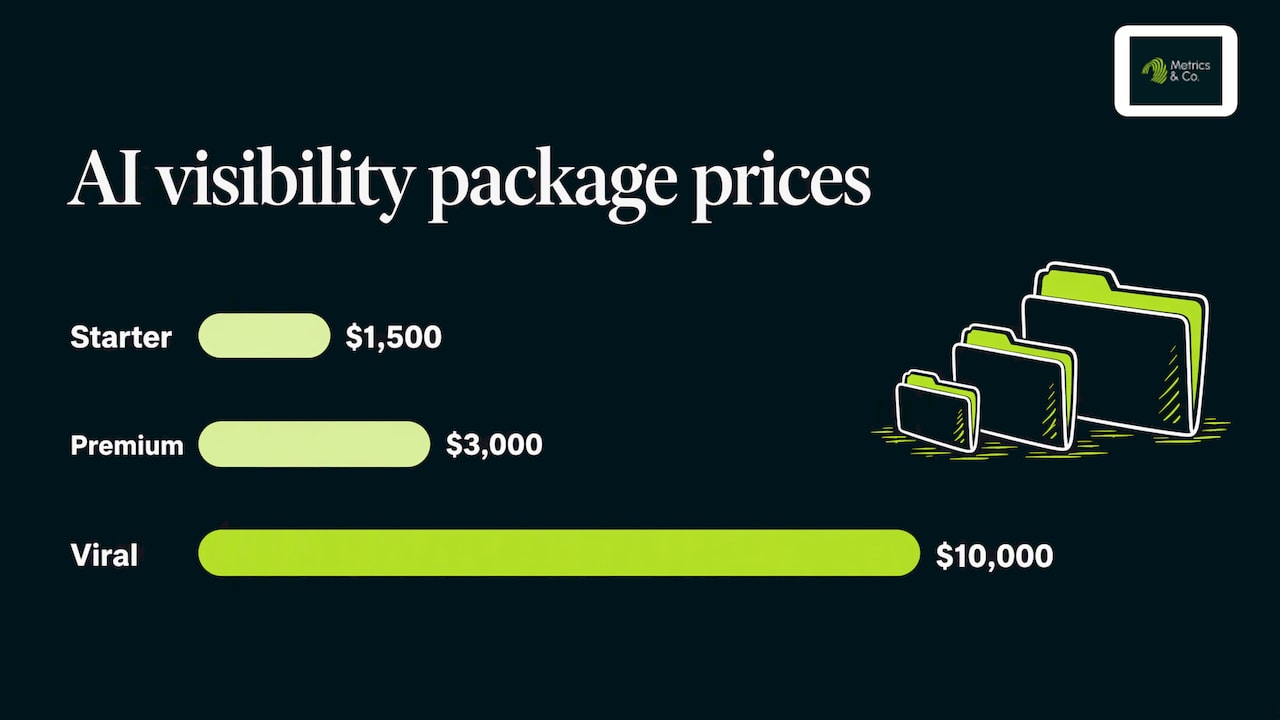
For teams that want a defined first step into AI visibility, the company offers one-off packages: Starter at $1,500, Premium at $3,000 and Viral at $10,000, described on the AI visibility page.
Teams that need a broader program can start from the SEO for crypto, fintech and forex page, which covers audit, content architecture, structured data, compliance and attribution reporting.
FAQ
What is SEO for financial services?
It is the practice of improving a financial company’s unpaid search visibility through content, technical site work and authority building. The aim is to attract clients who are researching a product or provider. In finance it also means meeting stricter trust and compliance standards than most other sectors.
Why is SEO harder for financial brands?
Google classifies financial topics as YMYL, which raises the bar for accuracy and credibility. Competition is intense, paid clicks are expensive, and regulation requires compliance review before content goes live. Strong expertise signals and a sound technical base are what let a financial brand compete.
Is SEO still worth it in 2026?
For financial brands, yes, and its role is widening. Visa’s whitepaper argues that SEO compounds over time and can lower dependence on paid media as advertising costs rise. Visibility now also includes being cited in AI answers, so a program should cover both search results and AI search.
How should a financial brand measure SEO results?
Track qualified leads and revenue from organic search first, then rankings, engagement and how often AI platforms name your brand. Agree on attribution rules and measurement limits before starting. That keeps the reporting tied to business outcomes rather than traffic alone.
Sources
- SEO for Financial Services: What It Is & How to Do It (Semrush)
- SEO for Financial Services: How to Build Trust and Rank (Ahrefs)
- SEO For Financial Services Brands: Key Trends (Search Engine Journal)
- SEO in the Era of AI-mediated Discovery (Visa)
Metrics & Co. specializes in performance marketing for high-stakes industries such as crypto, fintech, forex and e-commerce, combining analytics-driven strategies, AI search optimization and creative content development. Learn more at metricsandco.com.