
To refresh outdated content, diagnose why a page lost performance, then make a substantive update to the page itself: current facts, better answers, a sharper structure and the same URL. Google’s own Refresh Outdated Content tool does something different: it updates a search result for a page you do not control. For crypto, fintech, forex and e-commerce teams, where prices, rules and product details go stale quickly, the work is an audit-led program. Metrics & Co. runs SEO and content engagements for these markets, and the method below is the one a growth team can hold any provider to.
TL;DR
- Two things share the name. Google’s Refresh Outdated Content tool updates a search snippet for pages you do not own. An SEO content refresh edits your own page so it can compete again.
- Diagnose before editing. Rule out seasonality, technical faults and tracking errors, then read impressions and click-through rate (CTR) in Search Console.
- Prioritize by evidence of decay and business value, and keep the URL by default.
- Never change dates to look fresh. Google advises against it, and in regulated markets every changed claim needs a source and a review.
- Measure against a baseline over several weeks, not days.
Table of Contents
- Two meanings of “refresh outdated content”
- Why content decays faster in regulated categories
- Step 1: Confirm the decline is real
- Step 2: Read the Search Console signals
- Step 3: Decide what each page deserves
- Step 4: Refresh with information gain, not cosmetic edits
- Step 5: Build compliance into the refresh
- Step 6: Measure against a baseline
- Doing this at scale: what a refresh service should cover
- How Metrics & Co. fits
- FAQ
- Sources
Two meanings of “refresh outdated content”
The query mixes two unrelated jobs, and the top results mostly cover the first.
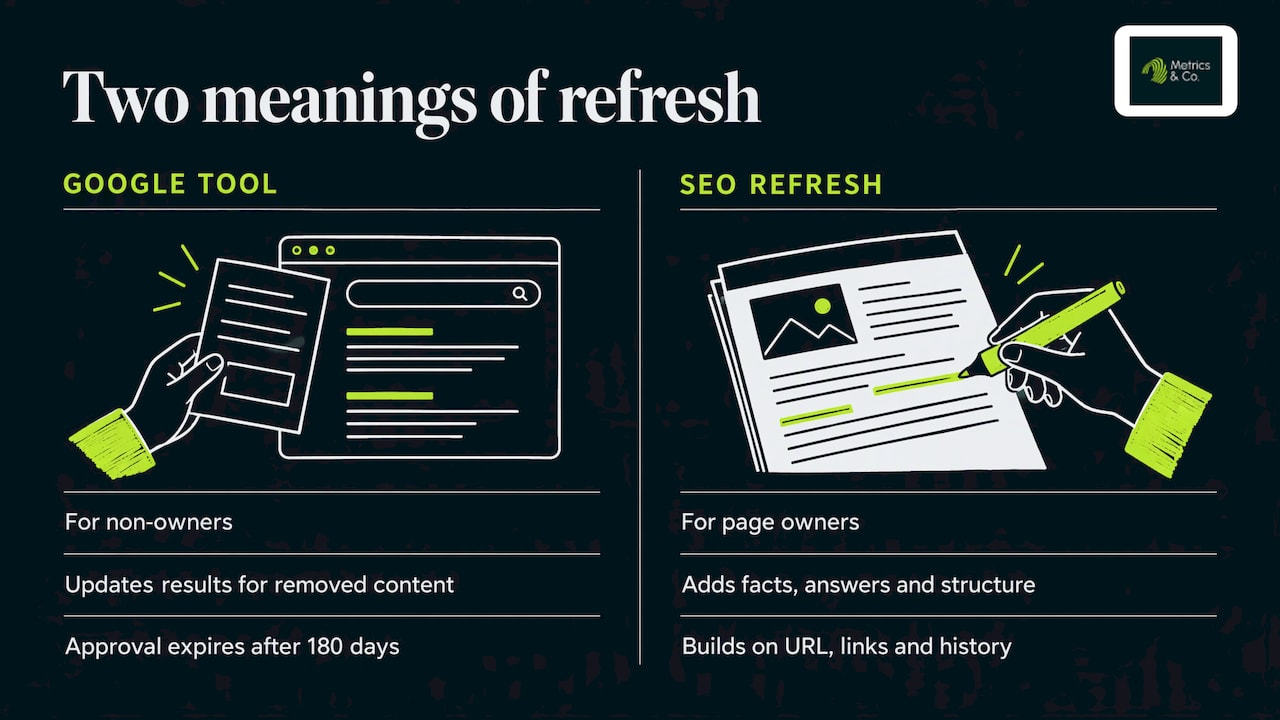
Google’s tool. The Refresh Outdated Content tool updates Google’s search result for a page or image that no longer exists, or that has removed important content. It is meant for people who do not own the page. Owners should use recrawl or page-hiding tools instead. It is not for wrong or harmful information, and it does nothing if the old text is still on the live page. Approved requests either drop an unavailable page from results or remove the snippet until the next crawl, and approval expires after 180 days.
An SEO content refresh. This is a meaningful update to an existing page: new facts, better answers, current examples, improved structure. It builds on the URL, links and history the page already has. If you own the page, this is the job.
The rest of this guide is about the second meaning, since the reader with a budget for it is the marketing or acquisition lead who owns the pages.
Why content decays faster in regulated categories
Content decay is industry shorthand, not a Google classification: a page becomes less fit for its job over time. Common causes in your sectors:
- Fintech: product terms, fees, eligibility rules and licensing language change, so comparison and explainer pages drift out of date.
- Crypto: token mechanics, exchange listings, tax guidance and regulatory status move on a short cycle.
- Forex: spreads, platform features, leverage rules and jurisdiction restrictions differ by market and change.
- E-commerce: models, prices, stock, buying guides and seasonal pages age by the quarter.
Search itself also moves. AI answer engines and new result formats can change who gets the click even when your page has not changed. That is why the first step is diagnosis, not editing.
Step 1: Confirm the decline is real
Not every traffic drop is decay. Search Engine Land’s decay guide advises ruling out three things first:
- Seasonality. Check Google Trends. A tax-season or holiday page will dip every year.
- Technical issues. Look in the Search Console Pages report for noindex tags, 4xx errors, unintended redirects or canonical changes.
- Tracking errors. Duplicate analytics code, missing tags and misconfigured filters create false drops. Compare analytics with Search Console data.
The same guide recommends tracking year-over-year traffic and rankings, and waiting at least six months before judging a page, because three months is too fresh. Compare like-for-like periods and isolate the page and its query set, so a site-wide event is not blamed on one article.
Step 2: Read the Search Console signals
Once the drop is confirmed, impressions and CTR show what kind of problem you have:
| Signal in Search Console | Likely meaning | First move |
|---|---|---|
| Impressions and CTR both falling | Classic decay: rankings slipping as competitors improve | Refresh content against current results |
| Impressions flat, CTR falling | A SERP feature, such as an AI summary or snippet, is taking clicks | Rework title, description and answer format |
| Impressions down, CTR up | Lost positions, but remaining visitors are engaged | Strengthen coverage of the queries you lost |
| Rankings steady, conversions falling | The page ranks but no longer persuades | Update offers, proof and calls to action |
Also check whether the search intent has changed. If the results now show a different kind of page than yours (a tool where you have an article, or a comparison where you have a definition), a light edit will not help. Check, too, whether a different URL on your own site now surfaces for the same query, which points to cannibalization rather than decay.
Step 3: Decide what each page deserves
Age alone is not a reason to rewrite. A page can be years old and still answer the query well. Search Engine Land’s prioritization guide recommends logging each URL’s purpose, Search Console data, leads or sales, backlinks, chosen action and reason, using a full year of analytics. The actions are update, consolidate, remove or leave alone.
A practical decision matrix pairs two questions: how strong is the evidence of decay, and how much does the page matter to revenue?
| Evidence of decay | Business value | Decision |
|---|---|---|
| High | High | Refresh first |
| Low | High | Keep and monitor |
| High | Low | Consolidate or retire deliberately |
| Low | Low | Leave alone |
Within “refresh”, there are three depths:
- Update: minor edits such as broken links, dates that are factually wrong and small corrections.
- Refresh: new facts, closed gaps, restructured sections and revised on-page SEO, with the URL unchanged.
- Rewrite: the core premise is no longer accurate or the intent has shifted, so most of the page is rebuilt. Keep the URL by default.
When two weak pages cover one topic, merge them into the stronger URL with a 301 redirect, which permanently points the old address to the new one. The same logic governs bigger changes such as a rebrand; our guide to redirecting, retaining or retiring URLs walks through it for fintech sites.
Typical first candidates are pages with revenue importance that lost traffic over the past year, rank on page two, show high impressions with low CTR, or contain outdated prices, product names, laws or years.
Step 4: Refresh with information gain, not cosmetic edits
Google’s guidance, as reported by Search Engine Land, warns against changing dates to make content look fresh when it has not substantially changed, and says adding or removing content merely to seem fresh will not help. Update the date only when the update is real.
A refresh that works usually contains:
- A claim check. List each factual claim, its current source, the source date and how volatile the fact is (a fee schedule is volatile, a definition is not). Replace volatile claims with primary sources. Where a historical figure stays, label it with its date instead of presenting it as current.
- New answers, not just new headings. Copying the headings of the top results gets you parity at best. Add what the current page lacks: a worked example, first-party data, a clearer comparison, a regulatory note.
- Current examples and statistics, each linked to its source.
- Revised title and meta description, especially where CTR is the problem.
- Internal links from and to newer related pages.
- Structure that can be extracted: a direct answer near the top, clear headings, tables and structured data, which helps both classic search and AI answer engines. Our overview of how AI answer engines cite sources covers what to build in.
A shorter page can be a deeper refresh if every remaining section serves the page’s job better.
What to leave alone: the URL, sections that already rank well and the page’s main topic. Changing them throws away the equity the refresh is meant to use.
Step 5: Build compliance into the refresh
For crypto, fintech and forex, a refresh is also a review event. Updated copy can introduce a claim that a regulator or an ad platform would reject. Treat each refreshed page as you would a new one:
- Check every rate, return, risk or eligibility statement against the current rule or product terms.
- Keep required disclosures and jurisdiction notes intact and visible.
- Route changes through legal or compliance review before publishing.
- Record what changed and why, so the next refresh starts from evidence.
Metrics & Co. publishes a compliance-safe content refresh system for fintech SEO that sets this routine out in detail. Its positioning is to make buyer objectives, evidence, scope and measurement limits explicit before work begins, which suits a program where each page carries regulatory exposure.
Step 6: Measure against a baseline
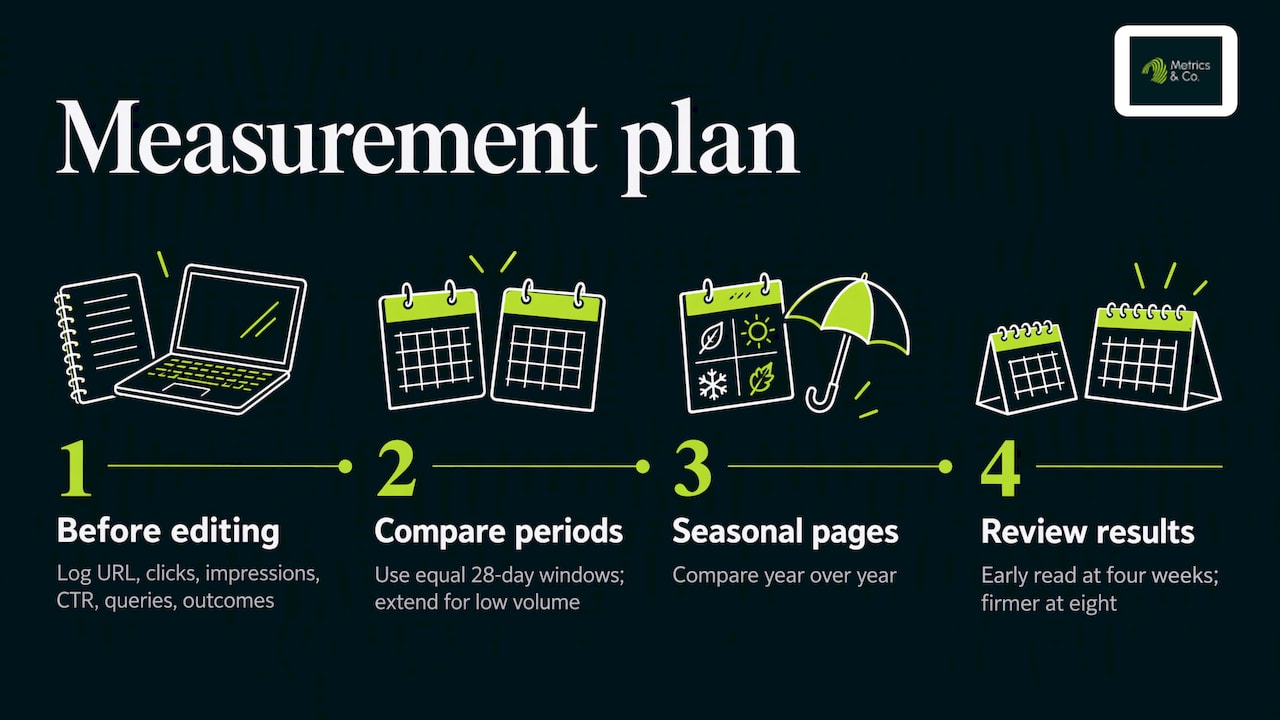
Capture the baseline before you edit: the page URL, clicks, impressions, CTR and top queries from Search Console, and on-site outcomes from analytics such as sessions, engagement, sign-ups or purchases. Search Console measures what happens before the visit and analytics measures what happens on the site, so the numbers will not match exactly.
Then compare equal windows before and after, for example 28 days against 28 days, or longer for low-volume pages. Compare year over year for seasonal content. Give the change time to register: recrawling and re-ranking take weeks, so a first check at four weeks is an early read, and a second at eight is firmer.
What can you expect? Evidence is mixed and mostly from publishers rather than regulated brands, so treat any figure as a range of outcomes. In a published experiment, Kapwing tested seven update types over 30-day before and after windows with a 10% success threshold. Four of the seven passed. Pages with high conversion but low rank improved average position from 27.5 to 21.5, and title and meta description updates on low-CTR pages lifted CTR from 0.62% to 0.96%. Seasonal swings skewed raw traffic, so the author leaned on average rank and CTR, which is a sound habit for your own reporting too.
Doing this at scale: what a refresh service should cover
A single page is a few hours of work. A library of hundreds of pages across several markets and languages is a program. When a team weighs outside help, the scope should include:
- A content audit that records each URL’s purpose, performance, links and recommended action.
- Diagnosis that separates technical, tracking and editorial causes before any writing.
- A prioritization based on evidence and revenue, not page age.
- Fact verification against primary sources, with compliance review for regulated claims.
- Technical SEO alongside the editorial work: redirects, canonicals, structured data and internal links.
- Attribution reporting with a baseline, so the result is measured against what was true before.
- Coverage for AI search visibility, since answer engines now draw on the same pages.
The reporting is the part to insist on. A provider that cannot show a baseline and a comparison window is selling activity, not results.
How Metrics & Co. fits
Metrics & Co. is a performance marketing agency for crypto, fintech, forex and e-commerce brands. Its SEO and organic growth and content marketing work covers audit, content architecture, structured data, compliance and attribution reporting, and its AI search optimization work (AEO and GEO) sits alongside technical SEO so refreshed pages are built to be found in both classic results and AI answers. Engagements run on a project or retainer basis. Our services overview lists the full set.

For teams whose first priority is visibility in AI answers, there are packaged one-time AI visibility campaigns: Starter at $1,500, Premium at $3,000 and Viral at $10,000, all one-off, described on the AI visibility page. Pricing for audit-led SEO and content engagements is not published.
FAQ
Is Google’s Refresh Outdated Content tool the same as updating my content?
No. The tool only updates how a page appears in Google’s results, and it is intended for pages you do not own. Updating your own content means editing the page, then letting Google recrawl it.
How often should I refresh a page?
There is no fixed schedule. Refresh when diagnosis shows decay, when facts such as prices, rules or product details change, or when search intent shifts. Review revenue-critical pages in your regular audit cycle, and leave pages that still answer the query well.
Should I change the publish date after a refresh?
Only if the changes are substantial. Google’s guidance, as reported by Search Engine Land, cautions against changing dates to make content seem fresh without real updates. Show an updated date where the update is genuine.
How long until a refresh shows results?
Allow weeks. Pages must be recrawled and rankings settle gradually, so check at around four weeks and again at eight, against a baseline captured before the edit. Seasonal pages need a year-over-year comparison.
Should I rewrite, consolidate or delete an old page?
Keep the URL and update when the page’s topic is still right. Rewrite when intent or the core premise has changed. Consolidate overlapping pages into the strongest URL with a 301 redirect, and retire pages only when they have neither traffic nor business value.
Sources
- Refresh Outdated Content tool, Search Console Help
- Content Decay: What It Is & How to Reverse Traffic Drops, Search Engine Land
- How to prioritize SEO content updates and new opportunities, Search Engine Land
- Refreshing content: How to update old content to drive new traffic, Search Engine Land
- Content Cleanup: How We Acquired 100k Users on Search by Updating Old Content, Kapwing
Metrics & Co. specializes in performance marketing for high-stakes industries such as crypto, fintech, forex and e-commerce, combining analytics-driven strategies, AI search optimization and creative content development. Learn more at metricsandco.com.