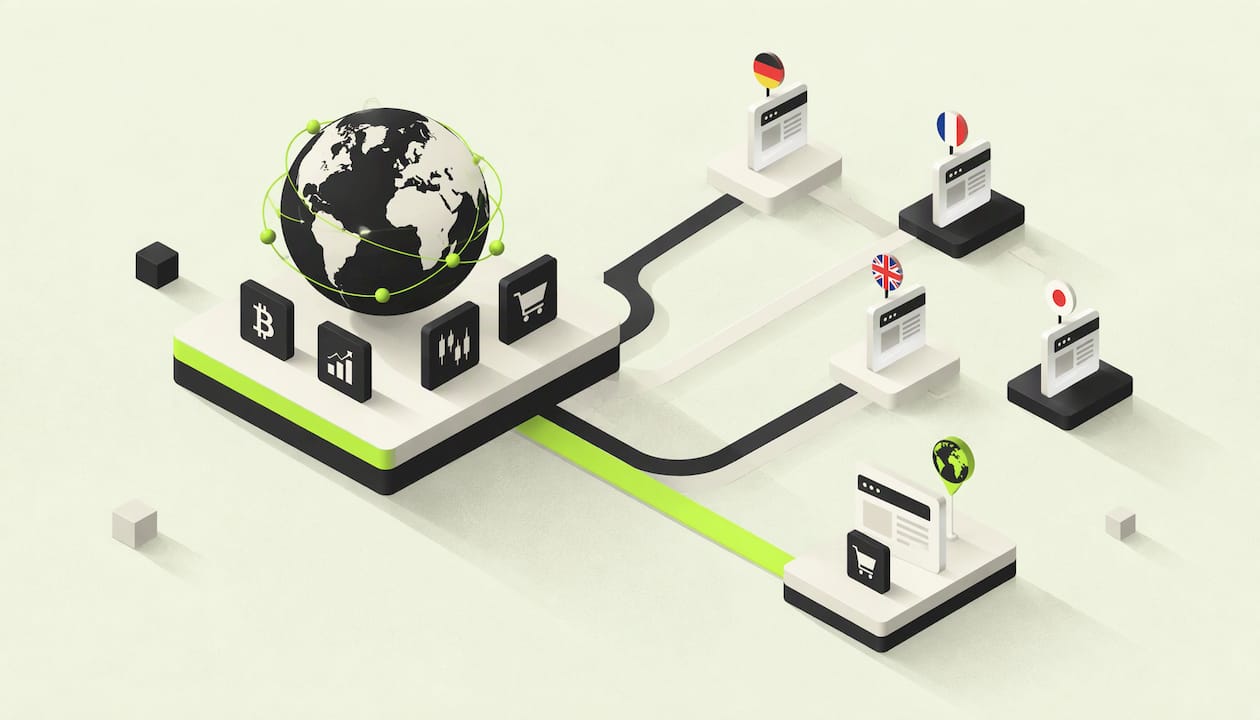
An international SEO strategy is a sequence of decisions made in a fixed order: which markets deserve investment, how the site is structured so search engines serve the right version in each, how content is localized rather than translated, and how results are measured per market. For crypto, fintech, forex and e-commerce brands, a fifth input comes first: where the product may legally be marketed. Metrics & Co. builds international programs for these sectors, where regulatory and platform constraints shape what a page can say and where it can appear.
TL;DR
- Select markets with data you already own (analytics, Search Console, sales records) and a weighted score, not by population or gut feeling.
- Give each language or country version its own URL, connect the versions with hreflang, and treat reciprocal tags and correct codes as non-negotiable.
- Build keywords from the local search results and native speakers, not from translated English terms.
- In regulated sectors, align each market page with licensing and availability before any content is written.
- Report each market separately, so a growing market cannot hide a declining one.
Table of Contents
- What makes international SEO different from standard SEO
- Step 1: Choose markets before you build anything
- Step 2: Pick a URL structure
- Step 3: Connect versions with hreflang
- Step 4: Research keywords in each market
- Step 5: Localize, do not just translate
- Step 6: Plan for AI search alongside classic rankings
- Step 7: Measure per market, not in aggregate
- What an international SEO service should cover
- Where to start with Metrics & Co.
- FAQ
- Sources
What makes international SEO different from standard SEO
International SEO is the practice of optimizing a site so search engines deliver the right version of it to users in each country and language. Search Engine Land separates it from multilingual SEO, which centers on language nuance, and from local SEO, which centers on map packs and location queries. Global brands usually layer all three.
Two points matter for a growth team.
It is not translation. The same source argues that international SEO means aligning structure, content and technical signals with how people in each region actually search. Poorly coordinated layers can dilute authority or confuse Google about which version to show where.
Language and country are separate variables. A Spanish page for Mexico and one for Spain are different targets. A French page for France, Canada and Belgium can need three variants. Planning by country-language pair, rather than by language alone, avoids most structural rework later.
For a fintech or exchange, there is a third variable: whether the product is available, licensed or permitted to be promoted in that country. That variable decides whether a market belongs in the plan at all.
Step 1: Choose markets before you build anything
The most expensive international SEO mistake is building a structure for markets that were never validated. A defensible selection uses three layers.
Start with what you already own
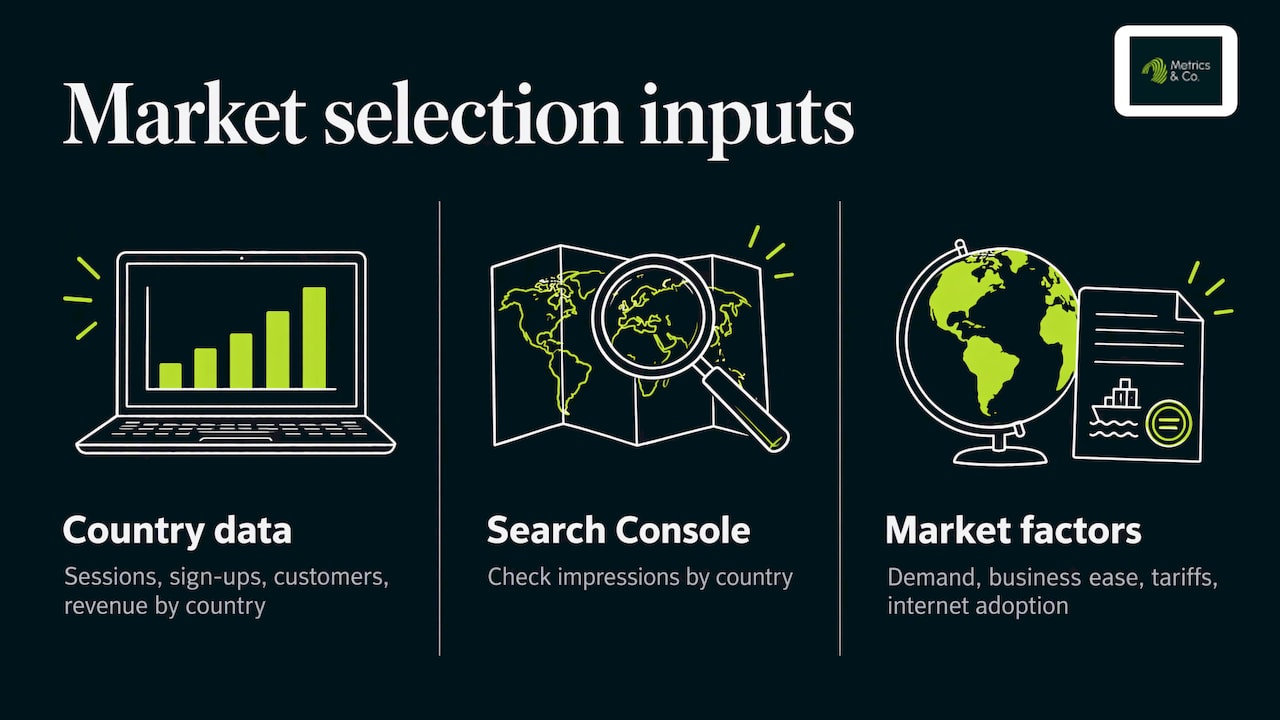
Pull sessions, sign-ups, paying customers and revenue by country from your analytics and CRM. Then open Search Console and look at impressions by country. Search Engine Journal recommends weighing search demand, ease of doing business, tariffs and internet adoption, and using existing analytics and Search Console reports, especially for countries where Google has already translated your snippet. Countries with impressions but poor rankings are uncaptured demand: people are already finding you without being served well.
Score the candidates
A simple weighted model keeps the discussion honest. An academic marketing text describes a two-stage screening process: a preliminary pass on macro indicators such as political stability, economic development and distance, then an in-depth pass where criteria are weighted to 100% and each country is rated 1 to 10 per criterion.
For the audience here, a practical version of the in-depth pass uses these criteria:
| Criterion | What to check | Why it matters |
|---|---|---|
| Non-brand search demand | Local-language volume for your core commercial terms | Brand searches only measure demand you already have |
| Competitive intensity | The top results for your 20 to 50 most valuable terms | Shows whether local players or multinationals own the page |
| Regulatory status | Licensing, permitted promotion, restricted terms | A page that cannot legally convert is wasted spend |
| Value per visit | Revenue or lifetime value in that market, if known | Cheap traffic from low-value markets does not pay back |
| Localization effort | Languages, payment methods, support, legal pages | Sets the real cost of entry |
Weights are yours to set, but fix them for the planning cycle so markets are compared on the same terms.
Launch narrow
Start with one or two markets. Adding a tenth language rarely pays back the way getting the first two right does, and every added version multiplies the technical surface that needs maintenance.
For regulated brands, market availability is also a content question. Metrics & Co. covers how to handle it in its guide to market availability pages for international fintech demand.
Step 2: Pick a URL structure
Google’s documentation on multi-regional and multilingual sites recommends a different URL for each language version, rather than relying on cookies or browser settings. It names country-code top-level domains (ccTLDs, such as .de for Germany) as a strong country signal and advises against adapting content by visitor IP address.
There are three common structures:
| Structure | Example | Country signal | Trade-off |
|---|---|---|---|
| ccTLD | example.de | Strongest | Treated as a separate site, so authority is built from scratch |
| Subdomain | de.example.com | Moderate | Inherits some domain strength but needs its own SEO work |
| Subdirectory | example.com/de/ | Weakest | Shares authority and one Search Console property; relies on localized content and hreflang |
These trade-offs are laid out in Shopify’s multilingual SEO guidance, which finds subdirectories most efficient for most stores because all versions share SEO strength.
For most fintech, crypto and e-commerce brands entering a first handful of markets, subdirectories are the practical default: one domain accumulates authority, one property reports everything, and each market can still be segmented. A ccTLD makes more sense when a market requires a separate legal entity, a local brand or a clear local-trust signal. URL parameters such as ?lang=de are the option to avoid.
Google also states that it uses visible page content, not the lang attribute or the URL, to detect a page’s language. It uses signals such as local addresses, phone numbers, currency and local backlinks to understand the target country. A page for Germany that shows prices in dollars and a US phone number sends mixed signals.
Step 3: Connect versions with hreflang
Hreflang annotations tell Google which URL is the equivalent version of a page for a given language and region. Google recommends them to link language versions. Search Engine Land’s best-practices guide lists the most damaging errors:
- Missing reciprocal annotations. If page A points to B, B must point back to A.
- Incorrect codes. The valid code for the United Kingdom is en-gb, not en-uk.
- Missing self-referencing tags. Each page must list itself.
- Orphaned configurations. Tags that point to URLs that no longer exist or that redirect.
The same guide recommends XML sitemaps or server-side generation for large sites and weekly monitoring in Search Console. Small mistakes repeated across hundreds of pages become expensive to fix.
Two further rules prevent most real-world failures. Each version’s canonical tag should point to itself, not to another language version. And URLs in hreflang sets must match the canonical URLs exactly, including protocol and trailing slashes.
Sites with many markets, licensing-based variants and gated content create unusual edge cases. Metrics & Co. documents them in its hreflang troubleshooting guide for multi-market fintech sites, and the broader technical groundwork in its technical SEO guide for fintech.
On machine translation, Google advises blocking automatically translated pages from crawling through robots.txt, because poor translation can be viewed as spam and affect how the site is perceived. Publish translated pages only after human review.
Step 4: Research keywords in each market
A translated keyword is a guess. Spanish speakers in Mexico and Spain may name the same product differently, and German searchers type compound words that a literal translation would never produce. A reliable method has five steps:
- Set up the local results page. Search Engine Land recommends starting from native search results: set Google’s location and language to the target country and read autocomplete, People Also Ask questions, local competitor terminology and market-specific result features.
- Ask native speakers. Take your 20 most valuable queries and ask in-country speakers how they would search for the same thing.
- Check volumes in a keyword tool set to that country and language.
- Inspect the top results in that country to see which page types win.
- Place the winning terms in the title, meta description, H1 and opening paragraph of the localized page.
Language choice changes what appears. A 2026 conference benchmark study of 30 matched Albanian and English query pairs found that Albanian queries returned a higher share of local results than English ones (a mean ratio of 0.73 against 0.49). Searching in the local language surfaces local commercial and institutional results that English queries miss.
Low or no search volume in a market where you perform well at home is also information. Search Engine Land notes it can point to a cultural mismatch, regulatory friction or different user priorities, which is useful for avoiding wasted investment.
Step 5: Localize, do not just translate
Localization means adapting examples, payment methods, legal wording, currency, tone and sometimes the whole page concept to the market. Practical rules:
- Translate the pages that carry revenue first: home, product, pricing, onboarding and support. Use analytics and Search Console to find them.
- Translate the elements around the body text too: title tags, meta descriptions, URL slugs, navigation, buttons, form labels, error messages and structured data.
- Decide per page whether to translate or write new content. If local searchers use different terms or ask different questions, a new page built on local research outperforms a translated one.
- Show the right currency, local payment options, regional contact details and language switchers. These are also the signals Google uses to infer the target country.
- Refresh localized content on a schedule, not only at launch.
For crypto, forex and fintech brands, localization has a compliance layer. Risk warnings, licensing statements, restricted claims and permitted promotions differ by jurisdiction, and a translated page can breach rules the source page met. The wording of every localized page should be checked against the local requirement before publication. Metrics & Co. sets out the technical and compliance considerations in its guide to SEO for regulated industries, and the approach to scaling templated pages in its piece on programmatic SEO for compliant acquisition.
Some markets also need attention beyond Google. Where Baidu or Yandex hold meaningful share, the technical and content requirements differ, which is a market-selection question as much as an SEO one.
Step 6: Plan for AI search alongside classic rankings
Users in every market now see AI-generated answers on top of or alongside classic results. International programs therefore benefit from structured data, clear entity information and consistent brand descriptions across language versions, so that AI systems can describe the brand accurately in each market. Metrics & Co. integrates technical SEO with AI search optimization (answer engine optimization and generative engine optimization) for brands that need accountable results. The measurement side is covered in its guide to tracking brand mentions in AI-generated content for regulated markets, and the budget question in GEO versus SEO content allocation.
Step 7: Measure per market, not in aggregate
A single blended organic traffic line can hide a failing market behind a growing one. Report each market separately against its own targets.
The U.S. International Trade Administration advises against trying to measure everything. Its guidance on international SEO analytics suggests starting with high-level metrics, such as monthly traffic over 6 or 12 months, time on content and international traffic sources, then digging deeper and using e-commerce KPIs to connect SEO with sales.
A workable reporting set per market:
- Technical health, weekly: hreflang errors, indexation and crawl issues in Search Console.
- Visibility, weekly or monthly: non-brand impressions, clicks and ranking for the priority terms.
- Traffic quality, monthly: engagement and share of visits from the intended country.
- Conversion impact, monthly: sign-ups, deposits, first transactions or orders per market, tied to your CRM.
- Market penetration, quarterly: share of the addressable non-brand demand you now capture.
Search Engine Land’s measurement guidance adds segmenting audiences by market type (primary, growth, test), normalizing currencies and tracking micro-conversions per market. Set a review point for each new market, for instance at 90 days, with three possible decisions: continue, change or stop.
Build the business case before launch. Sum the monthly search volumes of the keywords you can realistically rank for, apply click-through rates by position for a best and worst case, then add your known conversion rates to estimate leads and revenue. MultiLingual magazine describes this approach, and notes that rising zero-click behavior means even a first position now returns less traffic than it once did, so use conservative CTR assumptions.
What an international SEO service should cover
When you evaluate help, the scope should match the steps above: market selection, site architecture and hreflang, keyword research with native speakers, localized content, compliance review, and per-market reporting tied to revenue. A program that stops at translation covers one of those steps.
Metrics & Co. states that it specializes in high-stakes markets with regulatory and platform constraints, and that it makes buyer objectives, evidence, scope and measurement limits explicit before work begins. Its capabilities include audits, content architecture, structured data, compliance and attribution reporting, plus international and multilingual campaign management across crypto, fintech, forex and e-commerce.
Where to start with Metrics & Co.
Teams that want one partner for technical SEO, localized content and attribution across several markets can start with the SEO service for crypto, fintech and forex, which covers organic growth and technical SEO for these sectors.
For brands that want to understand how AI systems present them first, Metrics & Co. offers one-time AI visibility campaigns in three packages: Starter at $1,500, Premium at $3,000 and Viral at $10,000, listed on the AI visibility page. E-commerce teams can see the relevant offer on the e-commerce marketing page.
FAQ
How long does international SEO take to show results?
Timelines depend on the market, competition and how much authority the domain already has. A structured approach sets a review at around 90 days for a new market, checking technical health, early visibility and conversions, then deciding whether to continue, change or stop. Treat the first quarter as proof of direction, not final performance.
Should I use subdirectories, subdomains or country domains?
For most brands entering a few markets, subdirectories are the efficient choice because every version shares the domain’s authority and one Search Console property. Country domains give the strongest country signal but are treated as separate sites, so they suit markets that need a local brand or entity. Whichever you pick, connect the versions with hreflang.
Is multilingual SEO the same as international SEO?
No. Multilingual SEO focuses on serving people in different languages, while international SEO also covers targeting different countries, including regional variants of one language. A site can be multilingual without being international, and a brand targeting the US, UK and Australia is international even though it publishes in English only.
Can I use machine translation for new market pages?
Google advises blocking automatically translated pages from crawling, because poor machine translation can be treated as spam. Use translation as a first draft only, then have a native speaker adapt the wording, keywords and, for regulated products, the compliance language before publishing.
Sources
- International SEO guide, Search Engine Land
- International SEO strategy guide, Search Engine Land
- International SEO best practices and measurement, Search Engine Land
- Managing multi-regional and multilingual sites, Google Search Central
- Getting started in international SEO, Search Engine Journal
- Selecting the countries to enter, LibreTexts
- Understanding international SEO, U.S. International Trade Administration
- Language-aware evaluation of AI-driven search, CECIIS 2026 proceedings
- Building a multilingual SEO program, MultiLingual
- Multilingual SEO tips, Shopify
Metrics & Co. is a performance marketing agency for crypto, fintech, forex and e-commerce brands, combining analytics-driven strategy, SEO, AI search optimization and creative content to generate measurable growth. Learn more at metricsandco.com.