
Multi-touch attribution (MTA) assigns fractional credit for a conversion to each marketing touchpoint a customer interacted with, instead of giving all the credit to one click. For crypto, fintech, forex and e-commerce teams, where a buyer typically meets a brand several times across search, paid social, content and email before depositing or buying, it is the most direct way to see which channels deserve budget. It only works when tracking, identity matching and model choice are set up deliberately, and when its blind spots are measured with other methods. This guide covers the models, the build steps, cross-channel data, AI search traffic and the limits.
TL;DR
- MTA splits conversion credit across the touchpoints in a journey. Single-touch models (first or last click) give it all to one.
- Rules-based models (linear, time-decay, position-based) are simple to run. Data-driven and Markov-chain models weigh touchpoints by observed impact but need more data.
- A usable setup needs cross-channel event tracking, identity resolution, a defined attribution window and a model matched to journey complexity.
- MTA cannot see everything. Privacy settings, shared devices and missing data leave gaps, and rule-based weights do not prove incrementality.
- AI search is now a measurable layer: track citations, referral traffic and conversion influence next to classic channels.
Table of Contents
- What multi-touch attribution means
- Single-touch vs. multi-touch attribution
- The main multi-touch attribution models
- How to build a multi-touch attribution model
- Cross-channel attribution across devices and offline
- Including AI search traffic in attribution
- Limits of multi-touch attribution
- Where Metrics & Co. fits
- FAQ
- Sources
What multi-touch attribution means
Nielsen defines MTA as a marketing effectiveness technique that considers the touchpoints on the customer journey and assigns each fractional credit. The allocation can follow predefined rules or an algorithm that learns from user-level interaction data. The Interactive Advertising Bureau (IAB), the main US digital advertising trade body, frames the purpose as granular measurement of marketing’s effect on conversions so that future spend can be guided by evidence.
A concrete example for a crypto exchange: a user finds a comparison article through organic search, later clicks a paid social ad, then returns through a branded search and completes a first deposit. Last-click attribution credits branded search with 100% of the deposit. MTA credits all three, and the split tells the team that content and paid social are creating the demand that branded search then harvests.
Single-touch vs. multi-touch attribution
Single-touch attribution gives all credit to one touchpoint, usually the first or the last. MTA distributes credit across the interactions it can observe. Nielsen’s guide argues that fractional credit is more informative than first- or last-touch rules because it reflects more than one interaction in the journey.
This matters most where journeys are long and regulated. A forex platform or fintech app often has a research phase, a comparison phase and an account-opening phase, with compliance-driven friction between them. A last-click view will consistently overvalue the bottom of that funnel and starve the channels that start it.
MTA vs. marketing mix modeling
Marketing mix modeling (MMM) is a different method. It analyzes aggregate sales, marketing and business-driver data over time, so it can assess activity that user-level tracking cannot see, such as radio or broadcast television. The IAB guide notes that MMM covers non-addressable media that MTA may not observe, and it describes a unified approach in which MMM estimates inform MTA and the addressable-media coefficients are aligned across both models.
A practical rule: MTA answers “which digital touchpoints inside the journey earned credit”, and MMM answers “what did each channel contribute to total sales, including offline and brand activity”. Teams with mostly digital spend start with MTA. Teams with large brand, sponsorship or event budgets add MMM.
The main multi-touch attribution models
The IAB’s 2024 cross-channel guide describes the common models as follows (IAB, 2024):
| Model | How credit is distributed | Best suited to |
|---|---|---|
| First-click (single-touch) | All credit to the introductory touch | Judging which channels open journeys |
| Last-click (single-touch) | All credit to the final touch | Short, one-session purchases |
| Linear | Equal credit to every touch | A neutral baseline when no data exists to weigh touches |
| Time-decay | More credit to touches nearer conversion | Short consideration cycles and promotional pushes |
| Position-based | Disproportionate credit to first and last, remainder shared by middle touches | Journeys where discovery and closing both matter |
| Data-driven | Credit based on analysis of large datasets of touchpoint impact | Accounts with enough volume to model |
Nielsen adds that fractional attribution can use machine learning to allocate credit among influential touchpoints and by dimensions such as campaign, placement, publisher, creative and offer. The IAB describes Markov chains, an algorithmic approach, as a way to represent the probability of an event sequence based on prior events. In practice a Markov model asks how conversion probability changes when a channel is removed from the path.
Choosing between rules-based and algorithmic models
The IAB advises choosing a model that matches journey complexity and data availability. Three questions settle it:
- How many conversions per month do you record? Algorithmic models need volume. A team with a few dozen deposits or orders a month gets more stable answers from a position-based rule than from a model trained on thin data.
- How long is the consideration cycle? Time-decay suits a quick e-commerce purchase. A crypto or forex account that takes weeks to fund usually needs position-based or data-driven credit, since early touches carry weight.
- Who must trust the output? Finance and compliance teams accept a transparent rule more readily than a black-box score. Write down the rule and its reasoning before anyone sees results.
How to build a multi-touch attribution model
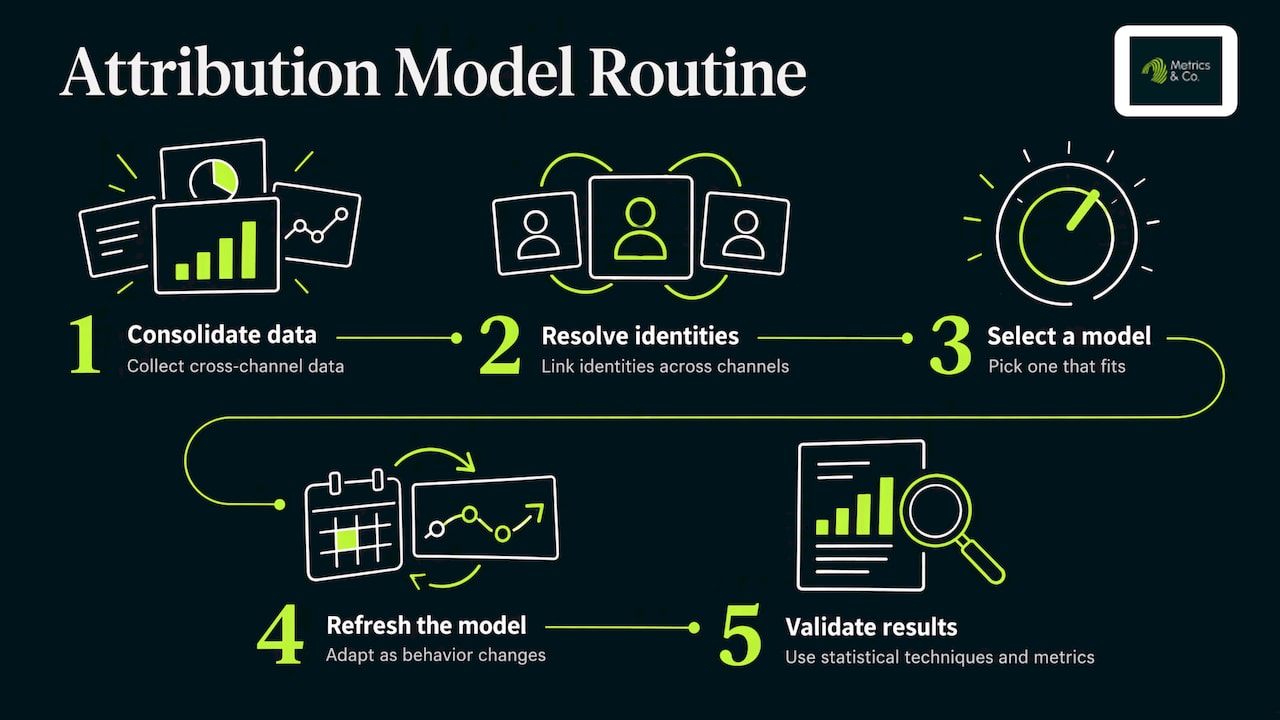
The IAB’s best-practice sequence is to collect and consolidate cross-channel data, resolve identities, pick a model that fits, refresh it as behavior changes and validate it with statistical techniques and metrics. Here is that sequence as a working routine, with where each step typically breaks.
Step 1: Define the conversion and the window
Decide which events carry credit: a funded account, a first trade, a completed purchase, a qualified lead. Then fix the attribution window, the number of days before the conversion in which a touch can earn credit. A window that is too short erases the research phase. One that is too long credits stale touches. The usual failure here is counting a low-value event such as a sign-up as the conversion, which rewards channels that bring in registrations that never activate.
Metrics & Co. states its approach as making buyer objectives, evidence, scope and measurement limits explicit before work begins, which is the discipline this step requires.
Step 2: Capture events across every channel
Every paid, organic, email and on-site interaction needs a consistent identifier and consistent campaign naming. The IAB recommends consolidated cross-channel reporting so that channels are compared on the same basis. Inconsistent UTM parameters, missing tags on app-install flows and untracked partner links are the most common sources of silent data loss. Metrics & Co. lists analytics and tracking and attribution reporting among its capabilities, covering this layer for growth teams.
Step 3: Resolve identities
A journey can only be assembled if the same person is recognized across sessions and devices. When identity links are missing or duplicated, the event trail fragments and journey-level attribution suffers, for example when one customer appears under separate work and personal emails. Match on logged-in user IDs wherever possible, and connect the CRM to ad and analytics data so that offline outcomes such as a verified account or a sales call are tied back to earlier touches.
Step 4: Select and run the model
Start with a transparent baseline (linear or position-based), run it next to last-click for one or two full conversion cycles and review where the two disagree. The disagreements are the actionable part: channels that gain credit under MTA are under-funded by last-click, and channels that lose credit are being over-credited.
Step 5: Validate and refresh
The IAB and the Media Rating Council, the US industry body that audits measurement, call for data accuracy, consistency, validation and verification. For a marketing team that means three recurring checks: reconcile attributed conversions against the backend source of truth, test the model’s credit shifts with a holdout or geo experiment, and refresh the model when channel mix, pricing or user behavior changes. For a worked example of testing whether a channel’s credit is real, see this guide on crypto brand search incrementality.
Cross-channel attribution across devices and offline
Cross-channel attribution is MTA applied to journeys that run through several platforms and devices. The IAB’s primer explains that cross-device measurement grew as media fragmented across mobile, tablet and connected TV, where cookies lacked support. Its methods remain the foundation: capture events across screens, use device graphs to link identities, connect digital exposure to offline purchases through audience graphs and CRM matching, and attribute calls with tracking numbers, customer-record matches or speech analytics.
For the audiences this guide targets, that translates into specific tasks:
- Crypto and web3: connect ad clicks to wallet connections and first transactions, since the on-chain event happens outside the ad platform. The guide on wallet connections and user activation shows where that event fits in the funnel.
- Fintech: tie acquisition touches to activation milestones such as card activation, not only application starts.
- Forex: pass lead quality and funding status back to the platforms so optimization follows funded accounts rather than form fills.
- E-commerce: unify email, paid social, search and marketplace traffic under one customer ID, and reconcile with order data.
Paid media is where misattribution costs the most, because platforms report their own conversions and each claims credit. A single cross-channel view prevents the same deposit from being counted two or three times. Teams working on paid channels can pair this with paid advertising for crypto, fintech and forex, and with the reading on ROAS vs ROI to decide which return metric the attribution output should feed.
Including AI search traffic in attribution
AI answers are now a discovery channel for financial and e-commerce brands, and they behave differently from classic referrals. A user may read a recommendation in an AI assistant, never click, and arrive later by typing the brand name. That visit shows up as direct or branded search.
The IAB’s AI-Era Attribution Blueprint, released on November 12, 2026, classifies conversions as Human-Owned, AI-Assisted or AI-Executed and separates a claim that is eligible for evaluation from credit actually awarded. It also recommends asking AI platforms to disclose whether recommendations are paid or organic, which sources informed them, and to label AI-originated traffic consistently.
MarTech’s report from the same day identifies five measurement layers for AI-first media: visibility in answers, citations, referral traffic, prompt-based discovery and conversion influence. A working approach for a growth team:
- Create a distinct channel group in analytics for referrals from AI assistants, so this traffic stops hiding inside “referral” or “direct”.
- Track brand citations and visibility in answers for a fixed list of commercial prompts, on a recurring schedule.
- Add a self-reported “how did you hear about us” field to sign-up or checkout flows and compare it against modeled credit.
- Watch branded search and direct traffic for lifts that follow gains in AI visibility.
Metrics & Co. offers AI search optimization (AEO and GEO) and integrates technical SEO with it, which is the work that makes a brand cited in answers in the first place. Attribution then shows whether that visibility turns into conversions.
Limits of multi-touch attribution
MTA is a model, and its output is an estimate. The IAB’s guide lists the main gaps: incomplete data, limited access, shared devices, cookie rejection and identity-matching problems can all cause interactions to be missed. The IAB and MRC guidelines add that modeled attribution may be needed when consumers or transactions cannot be identified, including because of cash purchases, payment or loyalty-card capture limits, and device or browser privacy settings.
The second limit is causation. Predetermined weights, whether first-click, last-click, equal or time-dependent, do not establish true incrementality. The IAB and MRC define incrementality as value above a baseline attributable to a marketing strategy after isolating other business influences. A channel can receive a large share of credit because it reaches people who would have converted anyway, as branded search often does.
The working response is to treat measurement as layers:
- MTA for day-to-day channel and campaign optimization.
- Incrementality tests (holdouts, geo splits) for channels where credit looks inflated.
- MMM for budget allocation across the full mix, including offline and brand spend.
The IAB also cautions that measured marketing ROI varies with product category, channels, investment, data availability and freshness, and the partner’s methodology, so a missing baseline complicates comparisons between vendors. Agree on the baseline and the measurement limits before a campaign starts, not after the first report.
Where Metrics & Co. fits
Building attribution touches tracking, creative, paid media, SEO and compliance at once, and in regulated categories each of those has constraints. Metrics & Co. is a performance marketing agency for crypto, fintech, forex and e-commerce brands. Its services include paid acquisition, organic and technical SEO, AI search optimization, funnel and analytics optimization and attribution reporting, and it describes its own edge as specializing in markets with regulatory and platform constraints and making scope and measurement limits explicit before work begins.
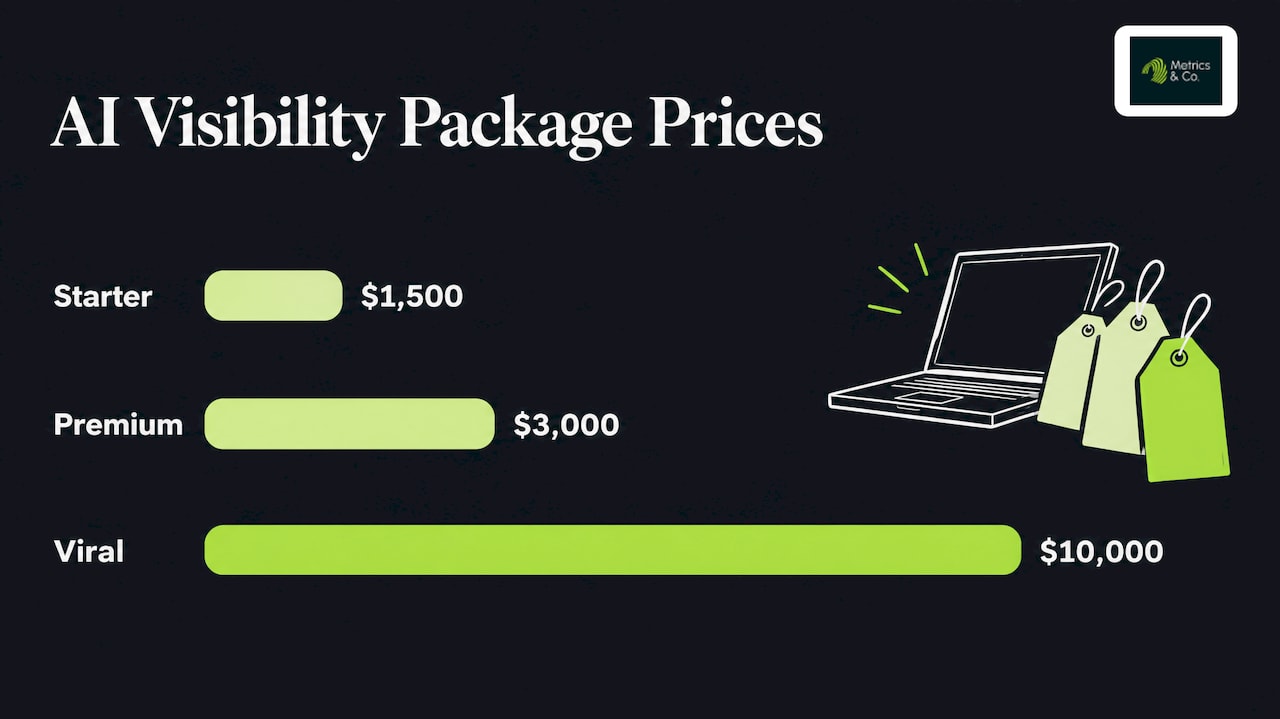
For teams that want AI search visibility measured and improved first, Metrics & Co. publishes three one-off AI visibility packages: Starter at $1,500, Premium at $3,000 and Viral at $10,000, listed on the AI visibility page. Teams that need ongoing paid, SEO, content and analytics work can review the full services overview.

FAQ
What is the difference between single-touch and multi-touch attribution?
Single-touch attribution gives 100% of the credit for a conversion to one interaction, typically the first or last. Multi-touch attribution spreads credit across the interactions it observes, using rules such as linear or time-decay or an algorithm. The second approach shows the contribution of channels that start or support journeys but rarely close them.
Which multi-touch attribution model should a new team start with?
Start with a transparent rule, linear or position-based, and compare it against last-click over at least one full conversion cycle. Move to data-driven or Markov-chain models when conversion volume is high enough for the model to be stable, and when identity resolution is reliable.
What is the difference between MTA and MMM?
MTA uses user-level data to credit individual touchpoints in addressable channels. MMM uses aggregate sales and marketing data over time and can assess non-addressable activity such as broadcast. The IAB describes combining the two so that their estimates inform each other.
How do I measure cross-channel attribution?
Consolidate events from every channel under consistent naming, resolve identities through logged-in IDs and CRM matching, and report all channels on the same conversion definition and window. Then reconcile the attributed totals against backend records so no conversion is counted twice.
Can AI search traffic be attributed?
Partly. Referral visits from AI assistants can be grouped as their own channel, and citations and prompt-level visibility can be tracked separately. Visits that follow an AI recommendation without a click usually appear as direct or branded traffic, so self-reported source questions and branded-search trends help fill the gap.
Sources
- Nielsen: Methods & Models, A Guide to Multi-Touch Attribution (2019)
- IAB: The Essential Guide to Marketing Mix Modeling and Multi-Touch Attribution (2019)
- IAB: Cross-Channel Measurement Best Practices for Marketers (2024)
- IAB/MRC: Retail Media Measurement Guidelines (2024)
- IAB: Digital Attribution Primer 2.0 (2016)
- IAB: AI-Era Attribution Blueprint (2026)
- MarTech: Building cross-channel measurement for AI-first media (2026)
Metrics & Co. is a performance marketing agency for crypto, fintech, forex and e-commerce brands. Learn more at metricsandco.com.