
A paid media strategy is a written plan that links a business objective to the channels, audiences, budgets, creative and measurement rules used to buy attention. For crypto, fintech, forex and e-commerce teams, the plan also has to account for platform eligibility and advertising restrictions before any budget is committed. Metrics & Co. builds paid programs for these markets, and the framework below follows the order in which that work is normally scoped: objective, audience, channel, budget, creative, measurement.
TL;DR
- Start from one commercial objective (verified leads, first deposits, purchases) and work backward to channels and budgets, not the other way around.
- Choose channels by the job they do: search ads capture existing demand, paid social creates it, and retail media and video serve specific stages.
- In regulated verticals, confirm platform eligibility and certification per country before building creative or forecasts.
- Test creative with explicit gates for spend and volume, and judge winners on downstream outcomes such as first deposits, not on cheap leads.
- Measure at the business level (blended efficiency) as well as per channel, and write down the limits of each metric before launch.
Table of Contents
- What a paid media strategy covers
- Step 1: Set the objective and the unit economics
- Step 2: Check platform eligibility before you plan
- Step 3: Choose channels by the job they do
- Step 4: Build the budget and the plan
- Step 5: Create and test paid ad creatives
- Step 6: Measure performance and fix underperformance
- Where a specialist adds value
- FAQ
- Sources
What a paid media strategy covers
Paid media is advertising in which the advertiser pays for placement in front of a chosen audience. Adobe’s definition separates it from owned media (your website, blog and email list) and earned media (press coverage, social mentions and reviews from others). The defining feature of paid media is control over targeting, timing and budget.
Harvard Business School Online divides paid media into paid search, where ads reach people actively searching, and display, where ads reach people who may be interested but are not searching. It also notes that paid media is strongest at the top of the funnel, while earned media carries more weight further down, where personal recommendations decide purchases.
That split has a practical consequence. Paid media buys reach and speed. It works best when owned assets (landing pages, content, product pages) are ready to receive the traffic, and when earned signals such as reviews and coverage support the final decision. A strategy therefore has four parts:
- Objective and economics: what a customer is worth and what you can pay to acquire one.
- Audience and channel mix: who you reach, and where.
- Creative and offer: what each audience sees at each stage.
- Measurement and optimization: how you decide what to scale, fix or stop.
Step 1: Set the objective and the unit economics
A plan that says “increase awareness” cannot be judged. A usable objective names a conversion event and a cost ceiling:
- Fintech: cost per funded account or per approved application.
- Crypto: cost per verified sign-up, or per first trade or deposit.
- Forex and CFD: cost per verified lead and cost per first deposit.
- E-commerce: return on ad spend (ROAS, revenue divided by ad spend) and contribution margin per order.
Work out the ceiling from lifetime value, not from the first transaction. If a funded account is worth $400 in gross margin over its first year and you need a payback inside twelve months, the ceiling for cost per funded account sits well below $400, after allowing for the share of leads that never convert. Write that number into the plan. Every later decision refers to it.
At this stage, also record the measurement limits: which events the platforms can see, which happen offline or inside an app, and which conversions arrive weeks later. Teams that skip this step usually end up arguing about attribution after the money is spent. Metrics & Co. makes buyer objectives, evidence, scope and measurement limits explicit before work begins, which is the same discipline this step describes.
Step 2: Check platform eligibility before you plan
For general consumer brands, channel choice is mainly a performance question. For crypto, fintech and forex, it is first an eligibility question. Ad platforms apply financial-services policies that differ by country and by product type, and some products require advance certification or a license before ads can run. Policies change often, so the right source is each platform’s current policy page for each target country, checked at the planning stage and again before every launch.
Treat eligibility as a planning input:
- List target countries and products first. A spot exchange, a wallet, a CFD broker and a payments app face different rules in the same country.
- Collect the regulatory documents that certification typically needs (registrations, licenses) before you build a timeline.
- Build the fallback mix early. If a platform restricts your product in a market, programmatic placements, sponsorships and organic channels carry more of the plan. Metrics & Co. covers that situation in its guides to programmatic acquisition beyond walled gardens and DSP options for crypto and forex.
- Write ad copy to the policy. Claims about returns, urgency and guarantees are the usual causes of disapprovals in financial categories.
Getting this wrong is expensive in a specific way: an account suspended mid-campaign takes learning, audiences and budget pacing with it.
Step 3: Choose channels by the job they do
CXL’s channel overview gives a useful way to sort channels: search ads capture existing demand, paid social reaches defined audiences and creates demand, display and programmatic handle retargeting and broad awareness, video explains products and builds memory, and sponsorships and creators borrow audience trust.
| Channel | Main job | Typical pricing model | Best fit |
|---|---|---|---|
| Search (Google, Microsoft) | Capture people already looking | CPC | Fintech and e-commerce with clear search demand |
| Paid social (Meta, TikTok, LinkedIn, X) | Create demand, reach defined audiences | CPM or CPC | Fintech apps, e-commerce, B2B fintech |
| Display and programmatic | Retargeting, awareness, reach beyond walled gardens | CPM | Crypto and forex where major platforms restrict |
| Video (YouTube, connected TV) | Explain the product, build recall | CPV or CPM | Products that need explanation |
| Sponsorships, newsletters, podcasts | Borrow trust from a niche audience | Flat fee | Crypto and fintech brands entering a community |
| Retail media and shopping ads | Reach shoppers at the point of purchase | CPC | E-commerce |
For e-commerce, Shopify’s 2026 PPC guide names four core channels: paid search, social media, retail media networks and AI search ads. It also explains that Google Shopping ads draw on product catalog data (titles, GTINs, prices, availability) rather than keyword bids. In practice that means feed quality is a bidding lever: a clean, complete feed often does more than another round of bid changes.
Paid social: structure and strategy
Paid social does not match keywords. CXL notes that it reaches people through audience signals, platform behavior, first-party data and predictive targeting, so channel choice has to match the targeting you need. It also warns that testing a single solution leaves you unable to tell whether another would have done better.
A structure that holds up for most accounts:
- Prospecting campaigns with broad or interest-based audiences and several creative angles, optimized to a high-quality event (verified sign-up, not just a click).
- Retargeting campaigns for visitors who started but did not finish onboarding or checkout, with a shorter lookback window and different messaging.
- Lookalike or seed-based audiences built from funded or paying customers rather than all sign-ups, so the platform learns from the customers you want.
- Separate budgets per objective, so a cheap retargeting audience does not hide a weak prospecting campaign.
For a worked fintech example of funnel structure on Meta, see Metrics & Co.'s write-up of Meta ads for fintech at 6x ROAS.
Step 4: Build the budget and the plan
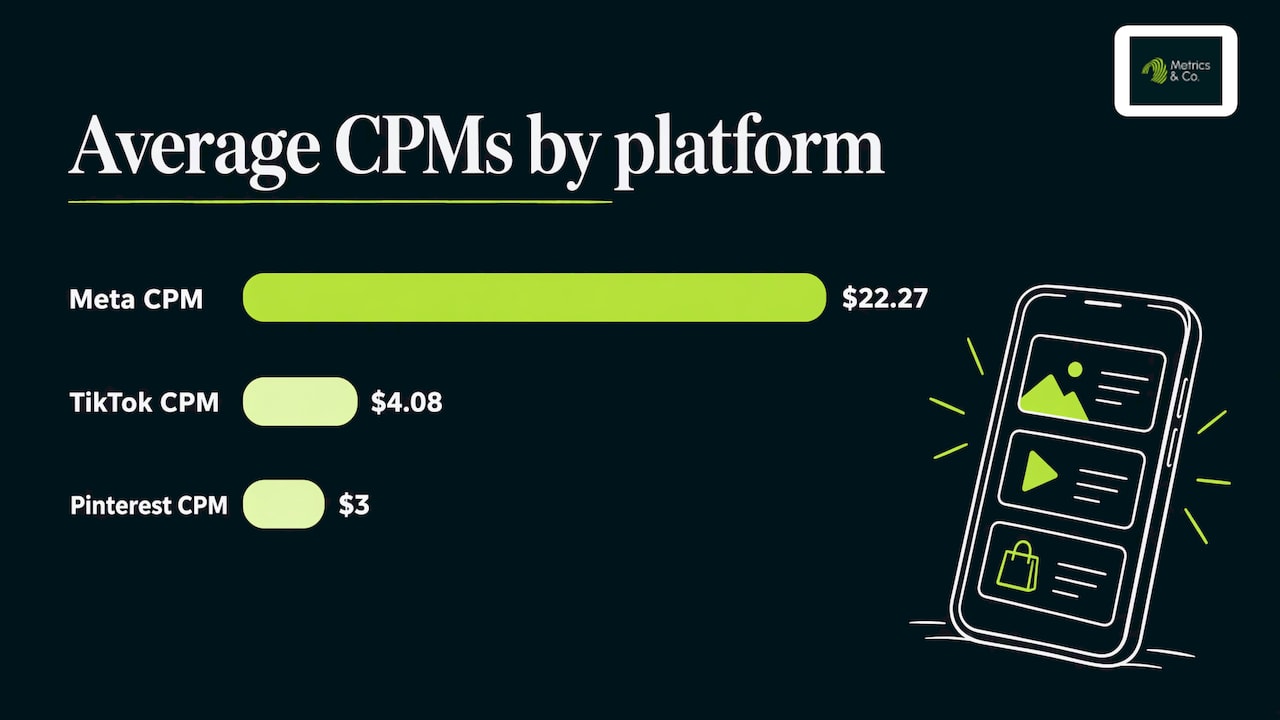
A paid media plan turns the objective and channel list into a budget by channel, a test schedule and a review cadence. Costs vary widely by platform. Shopify’s 2026 paid media guide reports average CPMs (cost per thousand impressions) of $22.27 for Meta ads, $4.08 for TikTok and $3 for Pinterest. Treat figures like these as orientation only, because CPMs differ by industry, audience and season, and financial services categories often run above general averages.
A practical way to split the budget:
- Core (about 60 to 70%) on the one or two channels with proven or most predictable demand, usually search plus one social platform.
- Expansion (about 20 to 30%) on a second or third channel with a defined test, such as programmatic or video.
- Experiments (about 10%) on new formats, audiences or creators, with a stop rule decided in advance.
These shares are a planning starting point, not a benchmark, and the right split depends on your payback target and how much volume the core channels can absorb. Define for each line item the learning period (enough conversions for the platform to optimize), the review date, and the condition under which budget moves up or down.
The plan should end up as a one-page table: objective, audience, channel, budget, creative theme, primary metric, guardrail metric, review date. If a row cannot be filled in, the strategy is not finished.
Step 5: Create and test paid ad creatives
Creative is usually the largest lever once targeting is automated, because platforms increasingly choose the audience for you. Plan creative by funnel stage:
- Awareness: the problem and a distinct angle, short video or static formats, no hard offer.
- Consideration: how the product works, proof points that are compliant for your market, comparisons of use cases.
- Conversion: the specific offer, onboarding steps, risk and fee information where regulations require it.
Testing needs rules, or it produces noise. A Finance Magnates article on broker ad testing describes a two-gate system for forex and CFD brokers. Gate one judges new creatives on cost per verified lead against the account median, at a 90-lead threshold. Gate two runs variable-level tests on deposits: a test cell closes at 15 to 20 first deposits (roughly $6,000 to $8,000 of attributed spend), and a winner is declared only when cost per first deposit is at least 25% below the control. The same piece describes a pipeline of 40 to 60 creatives a month, with about 29% of a $60,000 budget going to new hypotheses and the rest to executions of proven variables.
The principle carries across verticals. Decide the volume and the downstream metric before the test starts, and do not declare a winner on clicks or cheap leads. Metrics & Co. documents its approach in two guides on creative testing systems for regulated markets and paid ads in regulated verticals.
A simple creative matrix keeps tests clean: change one variable at a time (hook, format, offer, proof point, call to action), name every asset consistently, and log results by variable rather than by ad.
Step 6: Measure performance and fix underperformance
Platform dashboards report what the platform can see, and each platform credits itself. A sound measurement stack has three layers.
- Platform metrics (CTR, CPC, CPM, conversion rate) for diagnosing individual campaigns.
- Channel-level attribution (server-side tracking, CRM-connected events) to tie ads to funded accounts, deposits or orders.
- Business-level efficiency. Search Engine Journal describes Marketing Efficiency Ratio (MER), total revenue divided by total ad spend, as a metric that does not depend on which channel gets credit. The same article notes that MER cannot guide allocation within a budget and can be inflated by seasonality or organic growth, so it works as an anchor rather than a replacement for channel data.
The article also describes a lift check in which you cut a channel’s budget by 50 to 75% for a defined window and watch total business results rather than channel reports. For crypto brands, branded search is a common place to apply this logic; Metrics & Co. explains how in its guide to crypto brand search incrementality.
When results fall short
Diagnose in this order, because each step is cheaper than the next:
- Tracking: are conversion events firing and deduplicated, and do platform counts reconcile with the CRM or payment system?
- Landing page and onboarding: if click-through is healthy but sign-up completion is low, the problem sits after the ad.
- Creative: if click-through is low or cost per click is rising, the audience is tiring. Refresh hooks and formats first.
- Audience and structure: overlapping audiences, too many ad sets splitting the learning, or an optimization event that is too shallow.
- Channel fit: only after the first four, decide whether the channel is the wrong place for this product.
Six common planning mistakes are worth auditing against: targeting that is too broad, unintegrated channel data, reliance on the same few channels, too little experimentation, measuring the wrong things, and handing off leads before they are qualified.
Where a specialist adds value
A paid program in a regulated category involves more than media buying: eligibility checks, compliant creative, tracking that reaches deposits and funded accounts, and a reporting model the finance team accepts. Metrics & Co. is a performance marketing agency for crypto, fintech, forex and e-commerce brands, and reports more than $500 million in client revenue generated and a peak return on ad spend of 25.5x. Its paid advertising service covers paid acquisition for these categories, alongside SEO, content, analytics and funnel work that feed the same plan.
Teams that also want visibility inside AI search answers can choose a one-time AI visibility campaign: Starter at $1,500, Premium at $3,000 or Viral at $10,000, as listed on the AI visibility page. E-commerce teams can review the e-commerce marketing offer, and crypto teams the crypto marketing page. Prices for paid advertising and the other services are scoped per engagement.
FAQ
How much should I spend to start testing paid media?
Spend enough to reach the conversion volume your test rules require. In the broker example above, a single deposit-stage test cell closes after roughly $6,000 to $8,000 of attributed spend, so a budget below that cannot answer deposit-level questions. Smaller budgets can still test top-of-funnel creative on cheaper events, then move the winners to a deeper event.
What is the difference between paid media and paid social?
Paid media is the whole category of advertising you pay to place, including search, display, video, sponsorships and social. Paid social is the part that runs on social platforms, targeting people through audience signals and behavior rather than keywords.
Which paid channels work for crypto and forex brands?
That depends on each platform’s current policy in each target country, which can require certification, a license or an application. Plans usually pair whichever major platforms accept the product with programmatic placements, sponsorships and newsletters.
How long before a paid campaign shows results?
Platforms need a learning period, and conversions that happen days or weeks after the click, such as funded accounts, take longer to read. Set the review date in the plan from your typical conversion lag, and avoid changing budgets or creative before it arrives.
Sources
- What is paid media? Definition, strategies, and campaigns (Adobe)
- Paid vs. Owned vs. Earned Media: What’s the Difference? (Harvard Business School Online)
- Paid Media: Definition, Channels, Strategy & Examples (CXL)
- Ecommerce PPC: Strategies, Platforms, and Best Practices (Shopify)
- Paid Media: Guide for Ecommerce Business Owners (Shopify)
- Why Broker Ad Testing Needs to Look Beyond Cheap Leads (Finance Magnates)
- Why Incrementality Testing Alone Won’t Fix Your Paid Media Budget (Search Engine Journal)
Metrics & Co. specializes in performance marketing for crypto, fintech, forex and e-commerce brands. Learn more at metricsandco.com.